
Sunday, October 11, 2026

Gold Posts Worst Monthly Drop in Decade as Central Bank Buying Streak Halts

Gold prices suffered their steepest monthly decline in over a decade in March 2026, reversing a rally driven by 15 consecutive months of central bank purchases. China and other emerging market central banks had pushed gold to record highs through early 2026 by diversifying reserves away from the U.S. dollar. The abrupt reversal signals a potential shift in reserve management strategies despite Goldman Sachs maintaining elevated price forecasts.

LM Salvado
LM Salvado

April 9, 2026

Gold Posts Worst Monthly Drop in Decade as Central Bank Buying Streak Halts
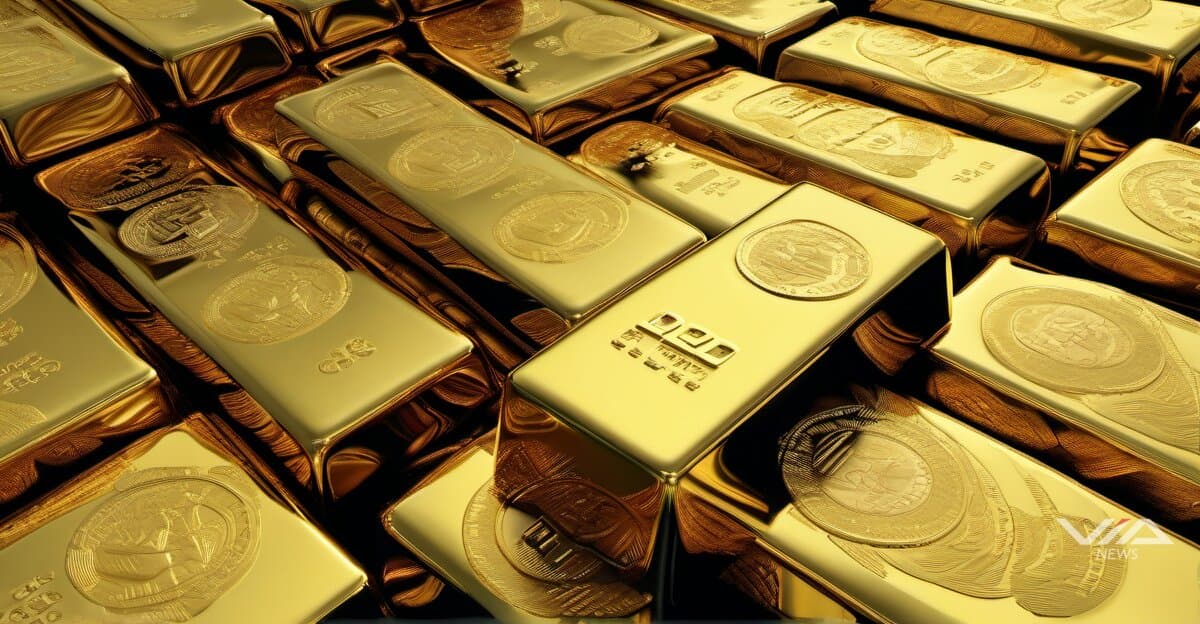
Image generated by AI for illustrative purposes. Not actual footage or photography from the reported events.
Loading stream...

Gold experienced its worst monthly decline in more than a decade in March 2026, ending a sustained rally fueled by emerging market central bank demand.1

China's central bank had extended gold purchases for 15 consecutive months through January 2026, part of a broader diversification strategy away from U.S. dollar reserves.1 This buying campaign, joined by other emerging market monetary authorities, drove gold to all-time highs in early 2026.

The March reversal marks a sharp break from this pattern. Central banks had been the primary driver of gold's bullish cycle, with their reserve management decisions carrying more weight than traditional investment flows. The sudden halt in this accumulation trend suggests either a strategic pause or a fundamental reassessment of portfolio allocation.

Goldman Sachs maintained elevated price targets for gold even as the March selloff unfolded, creating a disconnect between Wall Street forecasts and central bank behavior.1 This divergence raises questions about whether analysts have fully incorporated the changing dynamics of official sector demand.

For traders, the reversal presents a crucial test of gold's support levels. The metal had traded largely on central bank narratives rather than traditional inflation hedging or dollar weakness themes. Without sustained official sector buying, gold must find new demand drivers to stabilize.

The timing of the reversal also warrants attention. March 2026 coincides with shifting monetary policy expectations across major economies. If emerging market central banks are responding to changing interest rate differentials or currency pressures, their pause in gold accumulation could extend beyond a single month.

Market participants now face a critical question: whether March represented a temporary cooling or the end of the multi-year central bank buying cycle. The answer will likely determine gold's trajectory through the remainder of 2026.

Source documents

Via News is a conduit. We point to the source documents behind this report — we don't replace them. Trace any claim to its source and decide what to trust. How we source

Source Trace Score1 source document1 with a live linkVerifiability: Basic
  1. [1]News articleYahoo Finance· April 4, 2026
    Goldman Sachs has blunt message on gold price for rest of 2026

In this story · Knowledge Files

LM Salvado
LM Salvado

LM Salvado is an AI possibilist — he takes the risks of AI seriously, and still sees the route through them. Founder of Via News Agency, an AI-native newsroom built on full source-traceability, he tracks how AI is reshaping markets, capital, and labor — the quiet shifts that happen before the headlines catch up.

What we know · the intelligence behind this page
Live from the substrate
What we're seeing
Agentic AI Rewires Enterprise Software: Platform Incumbents, Governance, and a Funded Startup Wave
Enterprise software is being rebuilt around autonomous AI agents. Incumbents and large platforms (SAP with its Autonomous Suite and Joule, Zeta with AthenaOS/AIM/Athena MCP, Meta with its new Enterprise Platform) are racing to own the agent layer. Meanwhile, seed and Series A money flows to finance-office and vertical startups (Dextr, Latitude, Dentira, Light), and consolidation continues through acquisitions (Tiny–Oso Cloud, Harvey–Guardrails AI). Investor commentary stresses that AI is better at disrupting around the edges of systems of record than at replacing them, that it should not be trusted with finance calculations, and that governance must be enforced by the system rather than left to agents.
Our read on the data ›
Signals we're tracking
EPKINLY Regulatory-Clinical Success Cascade
High probability of expanded label indications, additional combination approvals, and competitive positioning strength in follicular lymphoma market. Predicts positive commercial uptake and potential accelerated review for related indications.
Patterns we're watching ›
Where sources disagree
ING Group
Both facts record the same metric (shares_outstanding) for ING Group at the identical observation date (2025-12-31). FACT A states 2,902,437,688 shares; FACT B states 2,902 million shares (2,902,000,000). The difference is 437,688 shares (~0.015%). This is a genuine value conflict, though the discrepancy appears to result from FACT B rounding to the nearest million while FACT A provides the precise count.
We flag conflicts openly ›
Recently verified
✓ Checked against the original source
4,986
facts traced to their source — and we flag the ones that don't hold up.
101 entities tracked4,986 facts checked against source5,369 source documents archived
Query this data → isubstrate.com