

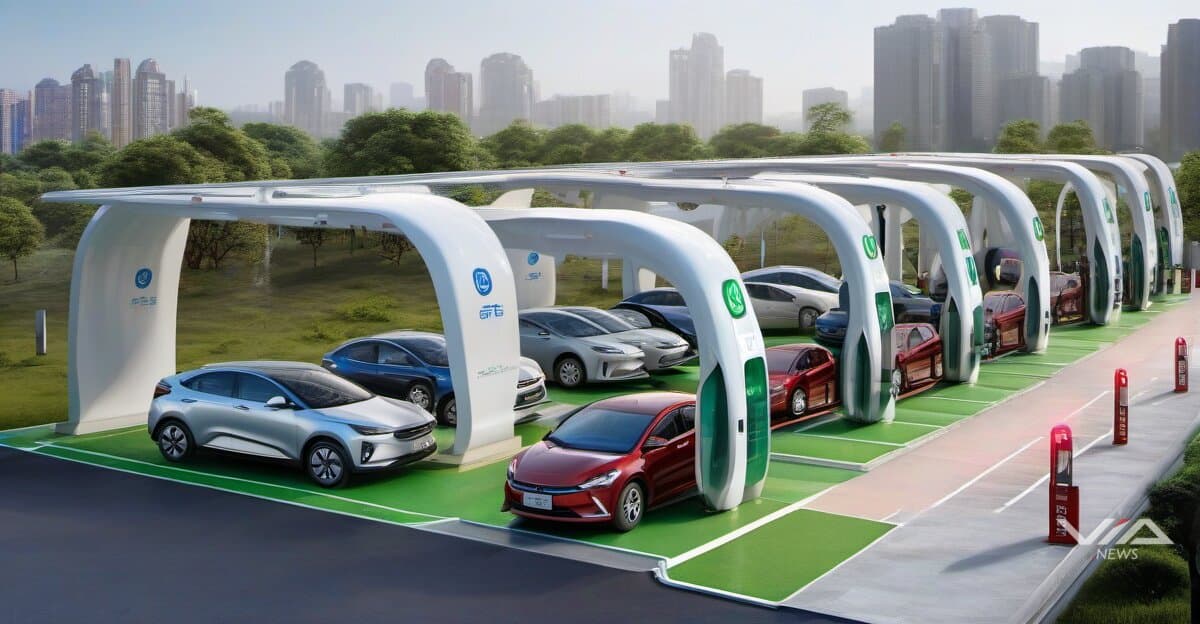
BYD is targeting 20,000 Flash Charging stations across China by end of 2026, with each unit delivering up to 1,500 kW of output.1 Tesla's Supercharger network peaks at roughly 500 kW — one-third the speed.1 The gap is not technical noise. It is a deliberate infrastructure wedge.
The buildout follows BYD's overtaking of Tesla in full-year 2025 global EV sales.1 That milestone was market share. This is market structure.
BYD partnered with Sinopec, China's state-owned petroleum giant, to anchor the rollout.1 The partnership converts existing fuel station sites into charging hubs, eliminating land acquisition costs and grid connection delays that greenfield charging sites require. For BYD, Sinopec's 30,000-plus station footprint is a distribution network it could not build from scratch at this pace.
Tesla's Supercharger network is growing at roughly 18% annually in China.1 BYD's expansion is outpacing that. Analysts project BYD matches Tesla's China station count within the year if current growth rates hold.1
The competitive calculus is direct. A BYD driver pulling into a Flash Charging station spends a fraction of the time a Tesla driver spends at a Supercharger. In a market where infrastructure availability influences purchase decisions, that experience difference compounds over time.
For investors, the Sinopec partnership is the structural detail that matters most. BYD is not constructing standalone charging infrastructure — it is embedding into China's existing energy distribution backbone. Foreign automakers cannot easily replicate access to that network.
China is the world's largest EV market. Infrastructure leadership there does not merely support vehicle sales — it shapes brand perception, reduces range anxiety, and raises the cost of switching to a competitor. BYD's 2025 sales lead over Tesla was the first data point. A charging network that surpasses Tesla on both scale and output speed would convert that lead from cyclical to structural.
Two metrics will confirm or challenge this thesis over the next 18 months: BYD's quarterly Flash Charging station count versus Tesla's China Supercharger count, and Tesla's China EV market share in H2 2026.1 If BYD crosses 15,000 stations by Q4 2026 and Tesla's share falls below 8%, the infrastructure strategy will have delivered the competitive moat it is designed to create.
BYD built the cars first. Now it is building the ecosystem.