
Saturday, August 22, 2026
What we know · the intelligence behind this page
Live from the substrate
What we're seeing
AI Platforms Rush to Establish Content-Authenticity Standards Amid Leadership Shakeups and Sustained Capex
Within days of each other in mid-August 2026, Google, Anthropic, and Spotify moved to formalize AI content watermarking and labeling policies, signaling an industry-wide push toward self-governed provenance standards as generative AI output floods consumer platforms. The shift coincides with executive turnover at OpenAI (Brad Lightcap's departure) and Meta's public AI manifesto, all set against continued heavy AI infrastructure capital expenditure and finance-sector moves (e.g., Wall Street paying for algorithmic edges on social signals) that underscore AI's deepening entanglement with capital markets.
Our read on the data ›
Signals we're tracking
Satellite-Terrestrial Network Integration Acceleration
Increased investment and launches in hybrid satellite-cellular networks across telecom industry; competitive responses from other carriers; regulatory activity around satellite spectrum; expansion of emergency/rural connectivity use cases
Patterns we're watching ›
Where sources disagree
JPMorgan Chase & Co.
Both facts report JPMorgan Chase & Co.'s revenue for the same fiscal period (FY 2025) with the same observation date (2025-12-31), but with different values: $182.447 billion vs. $185 billion. The ~1.4% difference ($2.553 billion) is too large to be explained by rounding alone and represents conflicting data for the identical time period.
We flag conflicts openly ›
Recently verified
Checked against the original source
4,977
facts traced to their source — and we flag the ones that don't hold up.
101 entities tracked4,977 facts checked against source5,242 source documents archived
Work with this data → vianewsagency.com

Bitdeer Converts Norway Mine to AI Data Center, Advances Ohio and Texas Buildouts in Single Earnings Cycle

Bitdeer (BTDR) is executing a simultaneous pivot across three fronts: converting its Norway Tydal site to an AI data center, deploying AI Cloud GPU capacity, and advancing US data center projects in Ohio and Texas. The moves, all surfacing within one earnings cycle, position BTDR for a potential re-rating from mining stock to AI infrastructure play. If earnings validate the model, peers including CORZ, RIOT, and MARA face pressure to follow.

L.M. Salvado
L.M. Salvado

May 19, 2026

Bitdeer Converts Norway Mine to AI Data Center, Advances Ohio and Texas Buildouts in Single Earnings Cycle
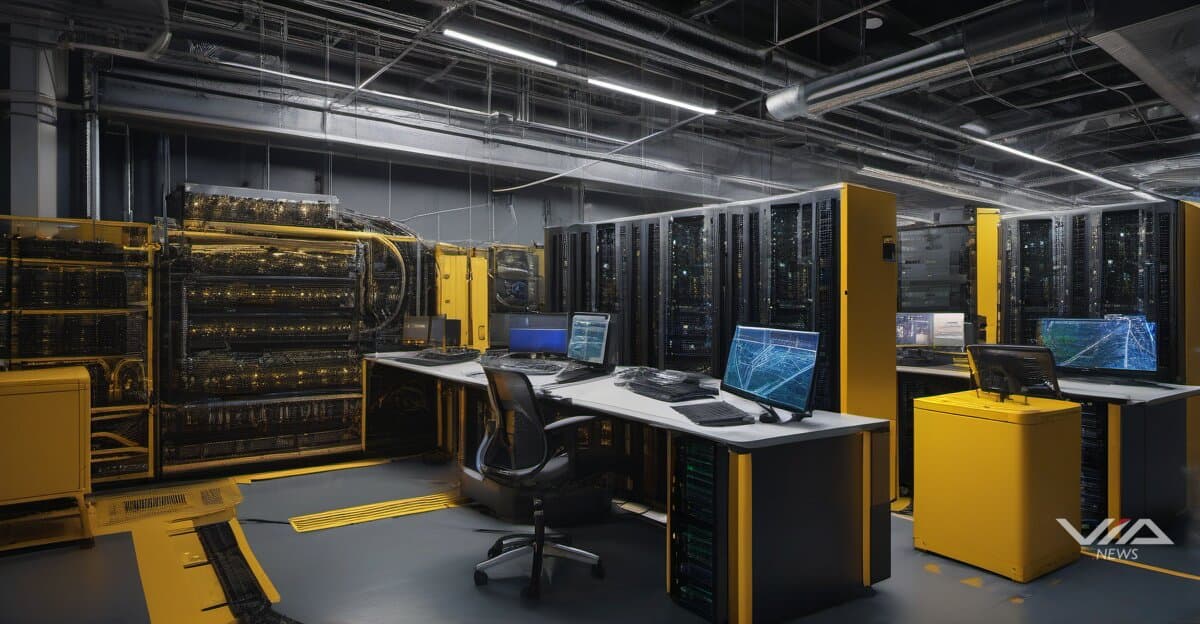
Image generated by AI for illustrative purposes. Not actual footage or photography from the reported events.
Loading stream...

Bitdeer (BTDR) is converting its Norway Tydal site from Bitcoin mining to an AI data center, while simultaneously deploying AI Cloud GPU capacity and advancing data center buildouts in Ohio and Texas — all within a single earnings cycle.1

The multi-front pivot signals a deliberate migration away from commodity mining economics. Bitcoin mining margins compress as network difficulty rises; AI compute margins expand with GPU demand. Bitdeer is arbitraging that gap.

The Tydal conversion carries strategic logic. Norway's cheap hydroelectric power and cold-climate cooling are infrastructure advantages that transfer directly from mining to AI workloads. The same power density and thermal management optimized for Bitcoin hashing can serve GPU clusters at comparable efficiency.

On the US side, Ohio and Texas data center projects extend the strategy into higher-margin, enterprise-facing markets. Both states carry deep hyperscaler investment, positioning Bitdeer alongside major cloud operators as a potential supply-chain partner.

The earnings cycle timing creates a re-rating opportunity. Analysts covering BTDR as a mining stock may need to apply AI infrastructure multiples instead. Mining stocks trade at structurally lower multiples than AI infrastructure peers. If GPU revenues scale, the stock could reprice accordingly.

The broader implication reaches across the sector. Core Scientific (CORZ), Riot Platforms (RIOT), and Marathon Digital (MARA) face the same margin pressure from rising Bitcoin difficulty and energy costs.1 A validated pivot by Bitdeer increases the probability of similar announcements from these peers.

GPU supply chains stand to benefit independently. Bitdeer's AI Cloud deployment requires Nvidia and AMD hardware at scale. Each miner that converts represents incremental enterprise GPU demand in an already constrained market.

The primary risk is execution complexity. Converting mining infrastructure to AI compute requires different power delivery architectures, higher-density networking, and reconfigured cooling systems. Simultaneous development across three sites amplifies that risk. Delays or cost overruns could pressure the stock even if the strategic thesis holds.

For investors, key earnings metrics to watch: AI Cloud revenue as a share of total, GPU deployment progress in Ohio and Texas, and Tydal conversion timeline guidance. Those numbers will determine whether BTDR re-rates — or retreats to mining stock valuations.1

In this story · Knowledge Files

About this analysis

This is a Via News analysis. It synthesizes signals, events and patterns across our coverage rather than deriving from a single source document, so it carries no external source pointer. Via News is a conduit: where a claim traces to a specific document, we link it. How we source

L.M. Salvado
L.M. Salvado

L.M. Salvado is an AI possibilist — he takes the risks of AI seriously, and still sees the route through them. Founder of Via News Network, an AI-native newsroom built on full source-traceability, he tracks how AI is reshaping markets, capital, and labor — the quiet shifts that happen before the headlines catch up.