
Wednesday, October 7, 2026

Micron's 2026 HBM Output Is Fully Sold Out, Setting Up Revenue Beat

Micron says its 2026 high-bandwidth memory production is fully sold out, pointing to AI accelerator demand outstripping memory supply. The guidance sets up a test: watch whether HBM revenue growth and margins outpace the rest of Micron's DRAM business over the next two to three quarters.

LM Salvado
LM Salvado

July 3, 2026

Micron's 2026 HBM Output Is Fully Sold Out, Setting Up Revenue Beat
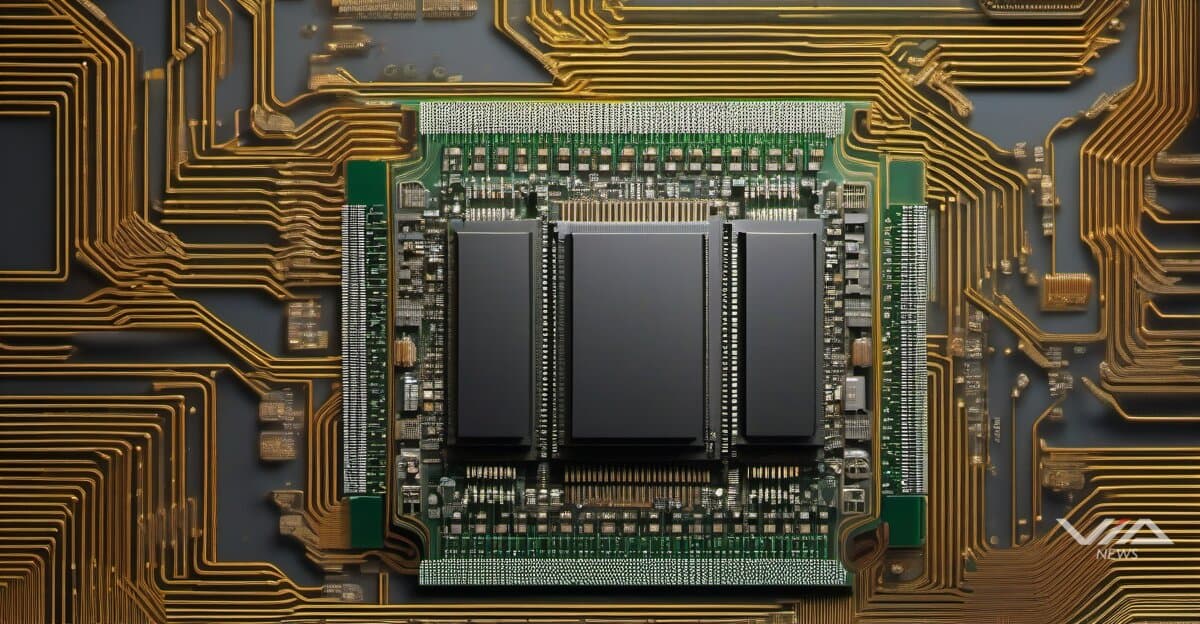
Image generated by AI for illustrative purposes. Not actual footage or photography from the reported events.
Loading stream...

Micron Technology's high-bandwidth memory (HBM) production for 2026 is fully sold out, the company disclosed in recent guidance.1 The disclosure signals that AI accelerator demand is outrunning memory supply heading into next year.

HBM chips pair with GPUs in AI training and inference systems. Nvidia, AMD, and other accelerator makers depend on HBM to hit performance targets. A sold-out 2026 order book removes near-term supply risk for Micron and points to pricing power.

Sanjay Mehrotra leads Micron as CEO through this cycle.2 His tenure now coincides with the company's tightest HBM supply-demand balance to date. The sold-out order book gives Mehrotra a rare position: capacity is the constraint, not demand.

The sold-out guidance implies HBM revenue could grow faster than Micron's broader DRAM business over the next several quarters. Analysts and investors will watch Micron's upcoming earnings reports for confirmation. Key metrics to track: HBM segment revenue growth rate and gross margin trends relative to prior company guidance.

If HBM revenue growth outpaces overall DRAM revenue growth by a wide margin over the next two to three quarters, it would validate the thesis that AI-driven demand is structurally repricing memory markets. Margin expansion in the HBM segment would reinforce that Micron is capturing scarcity value rather than just volume growth, not simply shipping more units at flat prices.

For traders, the setup favors upside surprises on Micron's revenue and margin lines in coming quarters, contingent on execution. The stock's near-term trajectory likely hinges on whether management raises guidance further as 2026 capacity commitments firm up, and whether that pricing power shows up in reported gross margin.

Risks remain: a slowdown in AI accelerator demand, or a rapid ramp in HBM supply, could narrow the gap Micron has priced in. As of the latest disclosure, sold-out 2026 output leaves the company with limited exposure to near-term demand softness. The next two to three quarterly reports will be the test.

In this story · Knowledge Files

About this analysis

This is a Via News analysis. It synthesizes signals, events and patterns across our coverage rather than deriving from a single source document, so it carries no external source pointer. Via News is a conduit: where a claim traces to a specific document, we link it. How we source

LM Salvado
LM Salvado

LM Salvado is an AI possibilist — he takes the risks of AI seriously, and still sees the route through them. Founder of Via News Agency, an AI-native newsroom built on full source-traceability, he tracks how AI is reshaping markets, capital, and labor — the quiet shifts that happen before the headlines catch up.

What we know · the intelligence behind this page
Live from the substrate
What we're seeing
Obesity and Immunology Readouts, Big Pharma M&A and AI-Designed Drugs Converge Into a Q4 2026 Catalyst Wave
Late-stage data and deal activity are clustering ahead of Q4 2026. Novo Nordisk's CagriSema won Best Abstract at EASD 2026 for its brain and body (fMRI/MRI) data, Lilly showed ADtouch results for EBGLYSS and agreed to buy Merida Biosciences for $2.9B, and Merck's tulisokibart hit its Phase 2b endpoints. A key regulatory catalyst follows: the FDA PDUFA date for the ivonescimab BLA on 2026-11-14. AI-designed rentosertib showing anti-aging effects adds a speculative AI-drug-discovery thread, while QAIAx's microcities trial and QIII pilot (planned 2027-01-01) are peripheral, forecast-only items.
Our read on the data ›
Signals we're tracking
Satellite-Terrestrial Network Integration Acceleration
Increased investment and launches in hybrid satellite-cellular networks across telecom industry; competitive responses from other carriers; regulatory activity around satellite spectrum; expansion of emergency/rural connectivity use cases
Patterns we're watching ›
Where sources disagree
ING Group
Both facts record the same metric (shares_outstanding) for ING Group at the identical observation date (2025-12-31). FACT A states 2,902,437,688 shares; FACT B states 2,902 million shares (2,902,000,000). The difference is 437,688 shares (~0.015%). This is a genuine value conflict, though the discrepancy appears to result from FACT B rounding to the nearest million while FACT A provides the precise count.
We flag conflicts openly ›
Recently verified
✓ Checked against the original source
4,985
facts traced to their source — and we flag the ones that don't hold up.
101 entities tracked4,985 facts checked against source5,351 source documents archived
Query this data → isubstrate.com