
Tuesday, September 1, 2026

Permian-to-Gulf Coast Pipeline Adds 2.5 Bcf/d Capacity by Late 2028, Tightening Natural Gas Basis Spreads

The Blackcomb Pipeline will connect Permian Basin supply to Gulf Coast LNG terminals with 2.5 billion cubic feet per day of capacity when commissioned in December 2028. The infrastructure links landlocked shale gas to export facilities, potentially narrowing regional price differentials and supporting Henry Hub futures. Energy infrastructure equities with midstream exposure stand to benefit from volume commitments backing the project.

Permian-to-Gulf Coast Pipeline Adds 2.5 Bcf/d Capacity by Late 2028, Tightening Natural Gas Basis Spreads
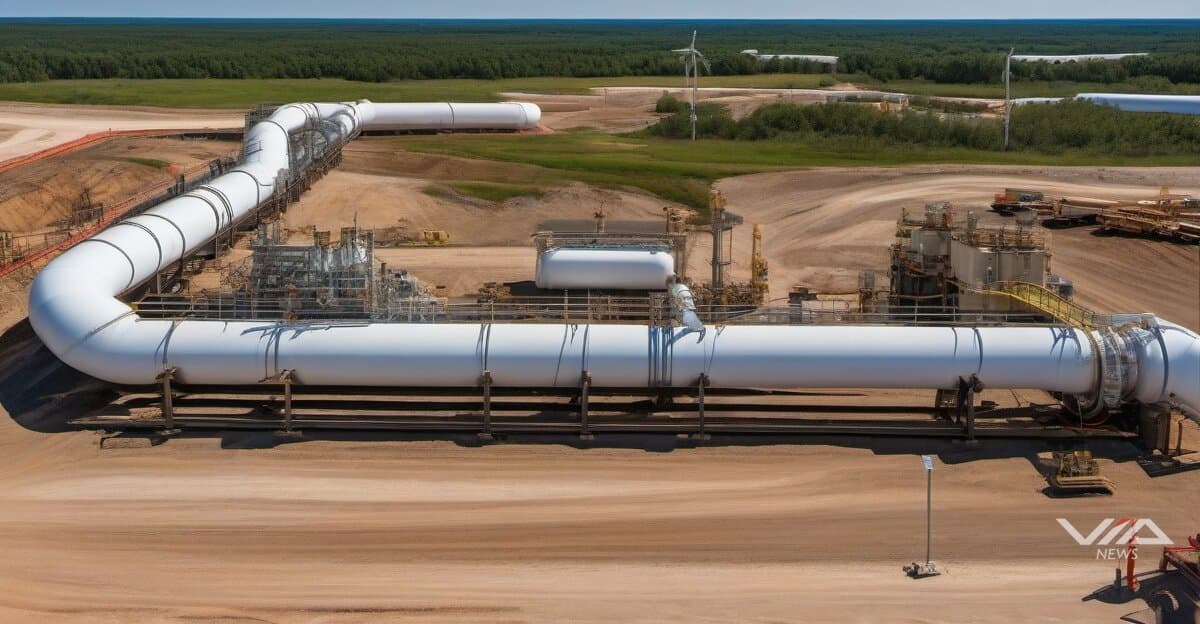
Image generated by AI for illustrative purposes. Not actual footage or photography from the reported events.
Loading stream...

The Blackcomb Pipeline will deliver 2.5 billion cubic feet per day of natural gas from the Permian Basin to Gulf Coast liquefied natural gas terminals when commissioned in December 2028. The project addresses transportation bottlenecks that have historically kept Permian gas prices at discounts exceeding $1.00 per MMBtu versus Henry Hub.

U.S. LNG export capacity is projected to reach 14.7 Bcf/d by 2028, up from 11.4 Bcf/d currently. Each new pipeline link reduces basis differentials between producing regions and export hubs, compressing spreads that averaged $0.87 per MMBtu in 2025. Traders positioning in Henry Hub futures should monitor how additional takeaway capacity affects supply-demand balances at the benchmark.

Midstream partnerships operating fee-based pipeline networks gain revenue visibility from long-term shipping contracts. MPLX, which owns stakes in multiple Permian gas gathering systems, trades at 8.2x forward EBITDA with a 9.1% distribution yield. Enterprise Products Partners and Energy Transfer also hold pipeline assets positioned to capture volume growth as Permian gas production climbs toward 17 Bcf/d by decade-end.

Natural gas futures markets are pricing in a $3.20-$3.80 per MMBtu range through 2028, reflecting export demand growth offsetting domestic consumption declines in power generation. Each 1 Bcf/d of new LNG capacity removes domestic supply, supporting floor prices. Infrastructure delays or export permit restrictions represent downside risks to this thesis.

Equity investors should weigh pipeline counterparty credit quality and contract structures. Take-or-pay agreements with investment-grade LNG developers provide cash flow stability. Companies with diversified asset footprints across multiple basins reduce exposure to single-region production volatility.

The 2028 commissioning timeline positions the Blackcomb system ahead of anticipated LNG demand peaks. Investors holding energy infrastructure equities or natural gas futures should track construction milestones and shipper commitments disclosed in quarterly filings. Basis spread compression between Waha and Henry Hub will signal whether pipeline capacity is effectively reaching export markets.

Source documents

Via News is a conduit. We point to the source documents behind this report — we don't replace them. Trace any claim to its source and decide what to trust. How we source

Source Trace Score1 source document1 with a live linkVerifiability: Basic
  1. [1]News articleYahoo Finance· February 20, 2026
    MPLX LP: Why This Midstream MLP Deserves a Premium Valuation
What we know · the intelligence behind this page
Live from the substrate
What we're seeing
AI Capital Surge: Late-August 2026 Funding Wave Spans Fintech, Enterprise Agents, and Robotics
A dense cluster of funding rounds landing on 2026-08-28 — from identity/fraud fintech player Socure ($156M plus its acquisition of Fravity) to enterprise AI agent startups (Instinct, Generalist AI, Owner), model infrastructure (Stability AI, Emerald AI), and autonomous logistics/aerospace (Gatik, Regent Craft) — signals investors are rotating aggressively into AI-native companies with demonstrable ROI, especially in financial risk/compliance and back-office automation. Parallel signals (Multiverse Computing's compression benchmarks cutting inference cost/latency, and Arkestro/CloneOps.ai publishing hard savings and labor-displacement figures) suggest the funding is chasing efficiency and measurable economic impact rather than pure model scale.
Our read on the data ›
Signals we're tracking
Satellite-Terrestrial Network Integration Acceleration
Increased investment and launches in hybrid satellite-cellular networks across telecom industry; competitive responses from other carriers; regulatory activity around satellite spectrum; expansion of emergency/rural connectivity use cases
Patterns we're watching ›
Where sources disagree
ING Group
Both facts record the same metric (shares_outstanding) for ING Group at the identical observation date (2025-12-31). FACT A states 2,902,437,688 shares; FACT B states 2,902 million shares (2,902,000,000). The difference is 437,688 shares (~0.015%). This is a genuine value conflict, though the discrepancy appears to result from FACT B rounding to the nearest million while FACT A provides the precise count.
We flag conflicts openly ›
Recently verified
Checked against the original source
4,980
facts traced to their source — and we flag the ones that don't hold up.
101 entities tracked4,980 facts checked against source5,267 source documents archived
Query this data → isubstrate.com
Permian-to-Gulf Coast Pipeline Adds 2.5 Bcf/d Capacity by Late 2028, Tightening Natural Gas Basis Spreads | ViaNews Market