
Saturday, September 19, 2026

Nuclear Energy Stocks and Data Center REITs Gain as AI Power Demand Surges

Tech giants are signing nuclear power deals to fuel AI infrastructure, with Meta securing three partnerships in January 2026 and the Trump administration launching an AI power initiative. Westinghouse landed a U.S. government reactor contract while GE Vernova raised guidance after its 2024 IPO, signaling investor confidence in energy infrastructure plays.

Nuclear Energy Stocks and Data Center REITs Gain as AI Power Demand Surges
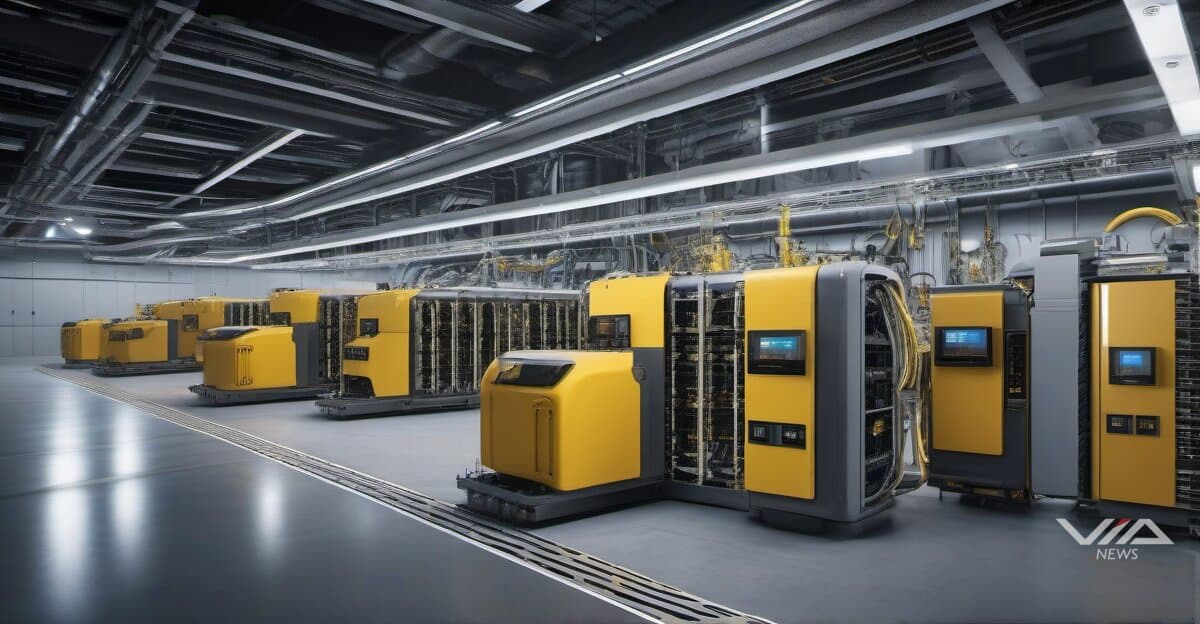
Image generated by AI for illustrative purposes. Not actual footage or photography from the reported events.
Loading stream...

Meta secured three nuclear energy partnerships on January 1, 2026, as AI workload demands pushed tech companies toward dedicated power sources. The Trump administration announced an AI power deal initiative the same day, accelerating a trend linking data center expansion to nuclear capacity.

Westinghouse won a U.S. government contract for nuclear reactor development, positioning the company to supply next-generation small modular reactors. These units deliver 50-300 megawatts each, matching the scale AI training facilities require without grid strain.

GE Vernova raised long-term financial guidance in December 2025, months after its April 2024 spinoff from General Electric. The stock has outperformed since its IPO, reflecting market confidence in power generation equipment demand. The company supplies turbines and grid infrastructure for both nuclear and renewable energy projects.

DMG announced partnerships for its Christina Lake AI data center on December 4, 2025. The facility will combine computing infrastructure with dedicated power sources, a model tech companies are adopting to avoid grid bottlenecks. Amazon, Google, and Microsoft have all announced similar data center-energy hybrid projects since mid-2025.

AI training runs consume 10-100 megawatts continuously, versus 1-5 megawatts for traditional data centers. Inference workloads add steady baseline demand as AI services scale to millions of users. This creates predictable, long-term revenue for energy suppliers and real estate operators housing the infrastructure.

Nuclear partnerships offer 24/7 baseload power without carbon emissions, avoiding renewable intermittency issues. Data center REITs with power-secured facilities command valuation premiums over peers relying on grid connections. Uranium prices rose 18% in 2025 on utility restocking and new reactor commitments.

Investors are tracking capital expenditure shifts. Meta, Amazon, and Microsoft collectively allocated $150 billion to infrastructure in 2025, with energy components growing from 5% to 12% of total capex. Nuclear suppliers, grid equipment makers, and specialized data center REITs are primary beneficiaries as AI adoption drives structural power demand growth through 2030.

In this story · Knowledge Files

What we know · the intelligence behind this page
Live from the substrate
What we're seeing
AI Boom Hits a Fork: Slowdown Calls Clash with Capex Confidence as Markets Get Nervous
Dario Amodei's repeated calls for a global slowdown in frontier AI development, echoed by Microsoft's new humanist AI code of conduct and FTC antitrust caution, are being publicly rejected by Nvidia and Meta leadership even as hyperscaler spending draws fresh skeptical scrutiny (Wachter's analysis, Burry-style overbuilding worries) and weak guidance from Adobe and a post-slowdown-comment selloff in GE Vernova signal investor jitters. Meanwhile wealth and security effects of the AI race keep compounding — Zhang Yiming's fortune surging on AI-driven ByteDance value, a Chinese hacking firm weaponizing AI against stolen government secrets, and low-quality AI-generated products (an AI sitcom, a spam-flooding agent platform) fueling backlash even as adoption races ahead.
Our read on the data ›
Signals we're tracking
EPKINLY Regulatory-Clinical Success Cascade
High probability of expanded label indications, additional combination approvals, and competitive positioning strength in follicular lymphoma market. Predicts positive commercial uptake and potential accelerated review for related indications.
Patterns we're watching ›
Where sources disagree
Berkshire Hathaway
Both facts report Berkshire Hathaway's cash position on 2026-01-01 with identical observation timestamps, but claim vastly different values: 380 billion USD vs 400 USD. These cannot both be true for the same entity at the same point in time. The magnitude of the discrepancy (a factor of ~10^9) rules out rounding, unit conversion, or methodological differences.
We flag conflicts openly ›
Recently verified
Checked against the original source
4,982
facts traced to their source — and we flag the ones that don't hold up.
101 entities tracked4,982 facts checked against source5,299 source documents archived
Query this data → isubstrate.com