
Sunday, October 11, 2026

First Business Financial Faces Deposit Flight Risk as 70% of Commercial Funds Remain Uninsured

First Business Financial Services carries elevated deposit stability risk with 70% of its commercial deposits exceeding FDIC insurance limits. The Wisconsin-based bank holding company remains vulnerable to rapid withdrawals following 2023's regional banking crisis, when depositor confidence collapsed at Silicon Valley Bank and First Republic.

First Business Financial Faces Deposit Flight Risk as 70% of Commercial Funds Remain Uninsured
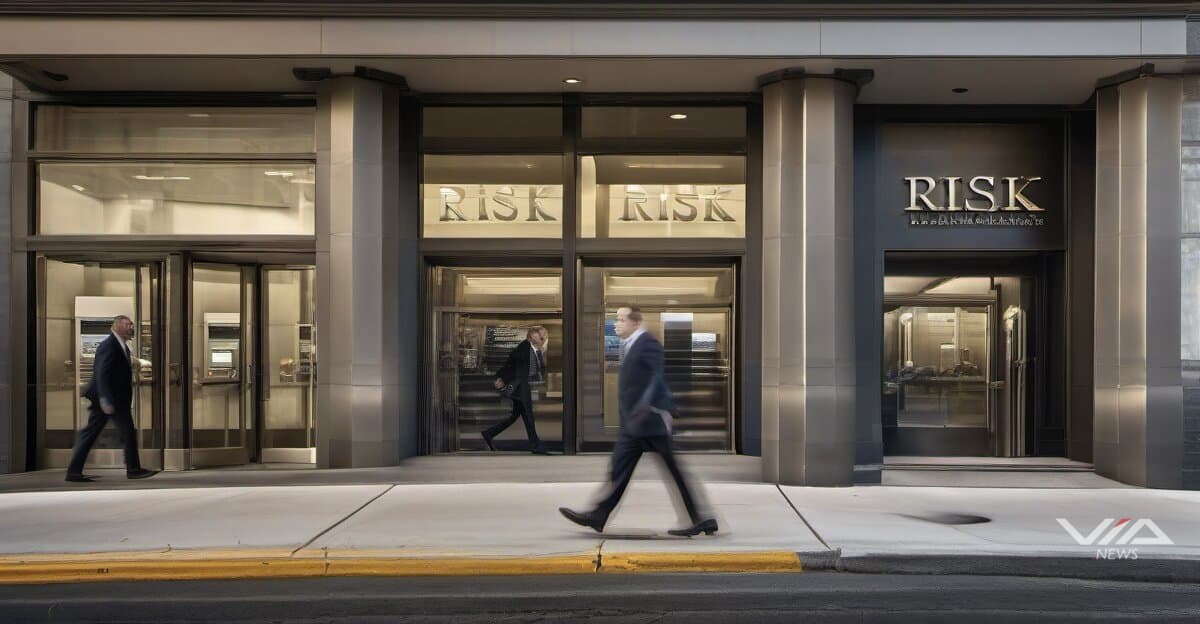
Image generated by AI for illustrative purposes. Not actual footage or photography from the reported events.
Loading stream...

First Business Financial Services holds $1.8 billion in uninsured commercial deposits, representing 70% of its total deposit base and creating catastrophic withdrawal risk if safety concerns resurface.

The Milwaukee-based bank holding company operates through First Business Bank, serving commercial clients, small businesses, and private wealth management. This client mix concentrates risk: business depositors maintain balances far exceeding the $250,000 FDIC insurance threshold.

Regional banks faced mass deposit flight in March 2023 when Silicon Valley Bank collapsed in 48 hours. Uninsured depositors pulled $42 billion from SVB in a single day. First Republic Bank lost $100 billion in deposits within weeks before failing.

First Business Financial's 70% uninsured ratio exceeds the 50% threshold that regulators flag as elevated risk. Banks with high uninsured deposit concentrations must maintain stronger liquidity buffers and capital reserves.

Commercial depositors monitor bank health metrics closely. A single adverse news cycle—credit losses, regulatory action, or management changes—can trigger rapid outflows. Unlike retail depositors, businesses move millions electronically within hours.

The bank's business model compounds the risk. Commercial banking, business lending, and wealth management clients maintain operational accounts requiring large balances. These relationships provide stable deposits in normal times but create concentrated flight risk during stress.

Regional bank stocks remain 35% below pre-2023 crisis levels. KBW Regional Bank Index trades at 0.9x tangible book value, reflecting persistent depositor sensitivity. Any institution with uninsured deposit concentrations faces valuation pressure.

First Business Financial must balance deposit costs against stability. Offering premium rates retains flighty deposits but compresses net interest margins. Lowering rates risks accelerating outflows to larger banks perceived as safer.

Bank regulators increased supervision of uninsured deposit concentrations following 2023 failures. Institutions face quarterly stress testing of deposit stability under adverse scenarios. Capital requirements may rise for banks exceeding uninsured thresholds.

Equity holders face asymmetric risk: deposit stability enables normal operations, but any loss of confidence triggers sharp valuation declines. Regional banks with commercial deposit concentrations trade at crisis discounts until uninsured ratios decline.

What we know · the intelligence behind this page
Live from the substrate
What we're seeing
Agentic AI Rewires Enterprise Software: Platform Incumbents, Governance, and a Funded Startup Wave
Enterprise software is being rebuilt around autonomous AI agents. Incumbents and large platforms (SAP with its Autonomous Suite and Joule, Zeta with AthenaOS/AIM/Athena MCP, Meta with its new Enterprise Platform) are racing to own the agent layer. Meanwhile, seed and Series A money flows to finance-office and vertical startups (Dextr, Latitude, Dentira, Light), and consolidation continues through acquisitions (Tiny–Oso Cloud, Harvey–Guardrails AI). Investor commentary stresses that AI is better at disrupting around the edges of systems of record than at replacing them, that it should not be trusted with finance calculations, and that governance must be enforced by the system rather than left to agents.
Our read on the data ›
Signals we're tracking
EPKINLY Regulatory-Clinical Success Cascade
High probability of expanded label indications, additional combination approvals, and competitive positioning strength in follicular lymphoma market. Predicts positive commercial uptake and potential accelerated review for related indications.
Patterns we're watching ›
Where sources disagree
ING Group
Both facts record the same metric (shares_outstanding) for ING Group at the identical observation date (2025-12-31). FACT A states 2,902,437,688 shares; FACT B states 2,902 million shares (2,902,000,000). The difference is 437,688 shares (~0.015%). This is a genuine value conflict, though the discrepancy appears to result from FACT B rounding to the nearest million while FACT A provides the precise count.
We flag conflicts openly ›
Recently verified
✓ Checked against the original source
4,986
facts traced to their source — and we flag the ones that don't hold up.
101 entities tracked4,986 facts checked against source5,369 source documents archived
Query this data → isubstrate.com