
Saturday, August 22, 2026
What we know · the intelligence behind this page
Live from the substrate
What we're seeing
AI Platforms Rush to Establish Content-Authenticity Standards Amid Leadership Shakeups and Sustained Capex
Within days of each other in mid-August 2026, Google, Anthropic, and Spotify moved to formalize AI content watermarking and labeling policies, signaling an industry-wide push toward self-governed provenance standards as generative AI output floods consumer platforms. The shift coincides with executive turnover at OpenAI (Brad Lightcap's departure) and Meta's public AI manifesto, all set against continued heavy AI infrastructure capital expenditure and finance-sector moves (e.g., Wall Street paying for algorithmic edges on social signals) that underscore AI's deepening entanglement with capital markets.
Our read on the data ›
Signals we're tracking
Satellite-Terrestrial Network Integration Acceleration
Increased investment and launches in hybrid satellite-cellular networks across telecom industry; competitive responses from other carriers; regulatory activity around satellite spectrum; expansion of emergency/rural connectivity use cases
Patterns we're watching ›
Where sources disagree
JPMorgan Chase & Co.
Both facts report JPMorgan Chase & Co.'s revenue for the same fiscal period (FY 2025) with the same observation date (2025-12-31), but with different values: $182.447 billion vs. $185 billion. The ~1.4% difference ($2.553 billion) is too large to be explained by rounding alone and represents conflicting data for the identical time period.
We flag conflicts openly ›
Recently verified
Checked against the original source
4,977
facts traced to their source — and we flag the ones that don't hold up.
101 entities tracked4,977 facts checked against source5,242 source documents archived
Work with this data → vianewsagency.com

DPM Metals' Serbian Gold Project Clears Feasibility Hurdle With $782M Valuation, 36% Returns

DPM Metals has completed a feasibility study for its Čoka Rakita gold project in Serbia, showing robust economics with a net present value of $782 million and 36% internal rate of return at $1,900 per ounce gold. The milestone positions the company to advance the project toward production, with first concentrate output targeted for 2029.

DPM Metals' Serbian Gold Project Clears Feasibility Hurdle With $782M Valuation, 36% Returns
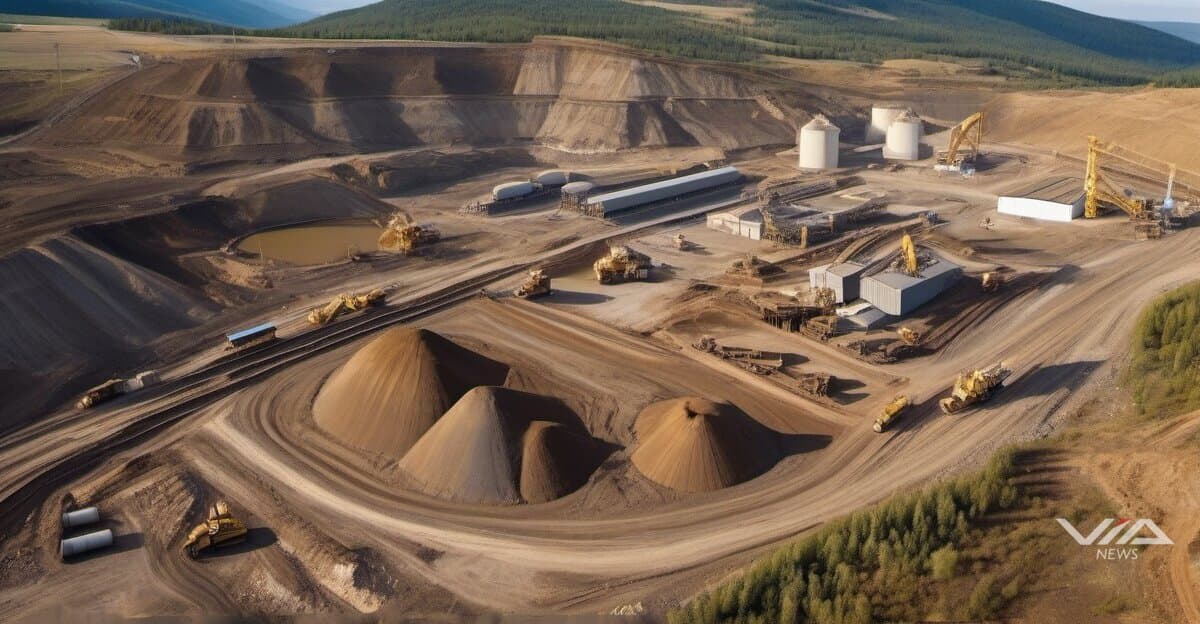
Image generated by AI for illustrative purposes. Not actual footage or photography from the reported events.
Loading stream...

DPM Metals has secured positive feasibility results for its Čoka Rakita gold project in Serbia, marking a significant step toward bringing a major new gold producer online in Eastern Europe. The study demonstrates strong project economics that could support self-funded development by the company.

The feasibility study shows the project generating a net present value of $782 million with a 36% internal rate of return, assuming a gold price of $1,900 per ounce. Probable mineral reserves total 1.52 million ounces of contained gold, an 11% increase over preliminary estimates, underscoring improved geological confidence as the project advanced through study phases.

All-in sustaining costs are projected at $644 per ounce, positioning Čoka Rakita in the first quartile of global gold operations by cost competitiveness. This cost profile provides substantial margin even in weaker gold price environments, a key consideration for project financing and long-term viability.

Initial capital requirements are estimated at $448 million, with the study projecting an 1.8-year payback period once production begins. DPM Metals currently holds $414 million in cash with zero debt, giving the company significant financial flexibility to self-fund development without requiring external financing or dilutive equity raises.

The company is targeting first concentrate production in 2029, contingent on advancing through permitting and final investment decision stages. Serbia has emerged as an increasingly important jurisdiction for European gold production as the continent seeks to reduce dependence on imported metals amid geopolitical tensions and supply chain concerns.

The feasibility completion represents the final major technical milestone before potential construction, moving Čoka Rakita from the study phase into permitting and financing considerations. For DPM Metals, the project represents a pathway to production-stage operations with economics that compare favorably to peer projects globally.

Gold projects achieving feasibility with sub-$700 per ounce sustaining costs have attracted significant investor interest in recent years, particularly those located in stable jurisdictions with existing mining infrastructure. Serbia's mining sector has undergone regulatory modernization in recent years, though permitting timelines remain a variable for project schedules.

The increased reserve estimate reflects additional drilling and geological modeling since preliminary assessments, a positive indicator for resource expansion potential as the project advances. Higher-confidence reserve figures typically improve access to project financing and reduce perceived development risk for potential partners or lenders.

Source documents

Via News is a conduit. We point to the source documents behind this report — we don't replace them. Trace any claim to its source and decide what to trust. How we source

Source Trace Score1 source document1 with a live linkVerifiability: Basic
  1. [1]Press releaseGlobeNewswire· November 26, 2025
    DPM Metals Announces Robust Feasibility Study Results for the Čoka Rakita Project with $782M of NPV5% and 36% IRR