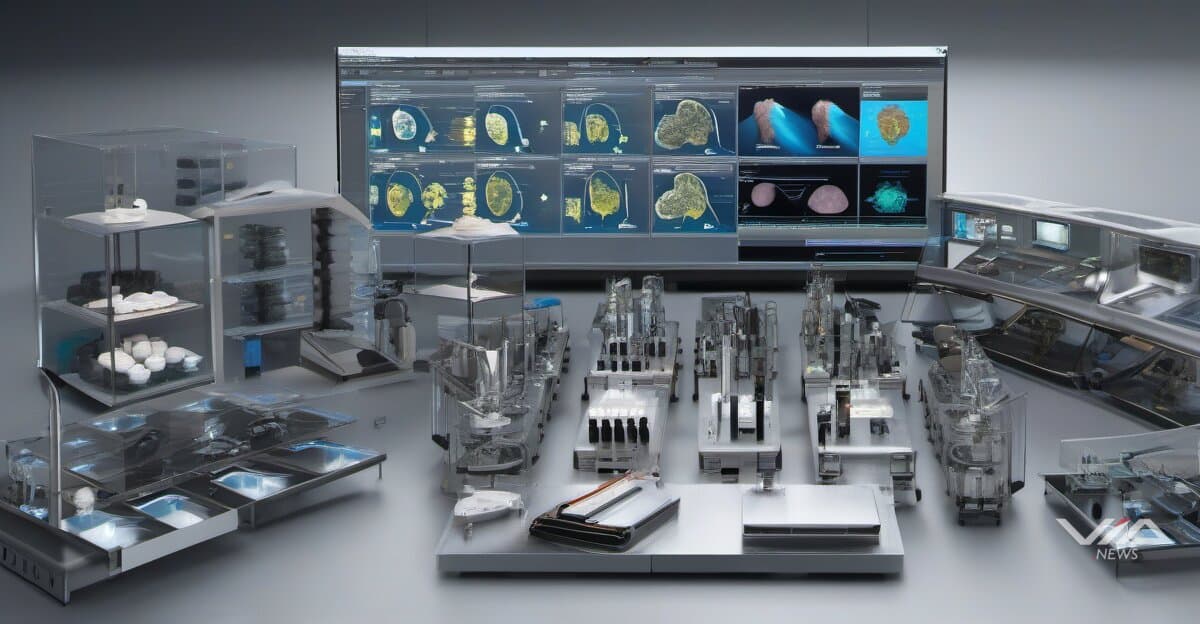
Novo Nordisk shares have extended gains through solid Q1 earnings, even as the drugmaker moves cell therapy manufacturing out of house.4 The company is licensing that work to AI-driven specialists like Cellular Intelligence rather than building it internally.4
The shift tracks a broader rotation: capital and R&D focus are moving toward AI-native platforms, not traditional biotech infrastructure.4 NVIDIA is anchoring that rotation with hardware partnerships tied to Thermo Fisher and Eli Lilly, while a cluster of AI foundation models — BioNeMo, MindWalk's HYFT and ReefIQ, Basecamp's EDEN, Edison's Kosmos, Owkin's OwkinZero, Boltz Lab — is being built out as infrastructure for drug discovery.1
MindWalk's HYFT Technology runs on roughly 660 million biological patterns, universal fingerprints encoding conserved relationships between sequence, structure and function.3 The company's pitch: the representation of biology itself is the hard part, and the place to build a durable advantage.3 Drug-discovery data is usually scattered across files, formats, systems and teams; AI systems need it reconnected into one governed, queryable web of context before they can reason about it.1
MindWalk has moved to patent-protect that data layer. Patent EP26187897.9 covers a computational layer built on top of its foundational HYFT patent (EP3881326A1) — not a re-filing, but new protection organizing biological meaning into a form reusable across its infrastructure and customer programs.2
MindWalk also gave the first public demonstration of ReefIQ, its newest platform tool, this month.1
For investors, the read-through is consolidation of value at the data layer: as majors like Novo Nordisk offload manufacturing and lean on licensed AI platforms, valuation weight in biotech is shifting from owned lab infrastructure toward the software and data layers that make discovery faster. Firms patenting their representation layer, like MindWalk, are positioning to capture that value directly.