
Saturday, September 19, 2026

Housing-Related Equities Eye 14% Sales Growth Forecast as Inventory Climbs, Lock-In Effect Fades

Economists project US home sales will rise 14% in 2026 as inventory improves and mortgage lock-in effects ease, potentially benefiting homebuilders, mortgage lenders, and real estate service stocks. Middle-income buyers currently afford only 21% of available homes versus 50% pre-pandemic, with median prices at $412,500. Price growth is expected to moderate to 2-3% as wages outpace both inflation and home prices.

Housing-Related Equities Eye 14% Sales Growth Forecast as Inventory Climbs, Lock-In Effect Fades
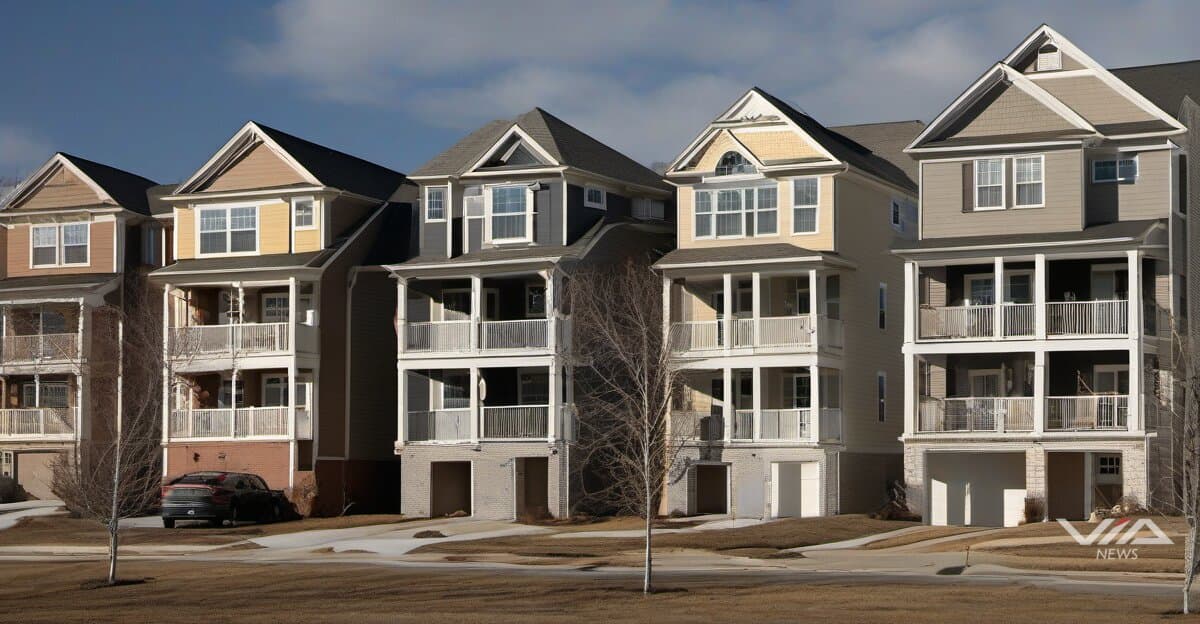
Image generated by AI for illustrative purposes. Not actual footage or photography from the reported events.
Loading stream...

US home sales are forecast to increase 14% in 2026 as inventory expands and the mortgage lock-in effect weakens, according to economists tracking the sector. The projection signals potential upside for homebuilders, mortgage originators, and real estate services companies navigating a market where affordability remains severely constrained.

Middle-income buyers can afford just 21% of homes currently for sale, down from approximately 50% before the pandemic, according to National Association of Realtors economist Nadia Evangelou. Median home prices stand at a record $412,500, while mortgage rates hover above 6%, creating persistent headwinds for residential construction stocks and lending platforms.

"We are seeing a little better condition for more home sales with more inventory and the lock in effect steadily disappearing because life changing events are making more people list their property to move on to their next home," said Lawrence Yun, NAR chief economist.

The easing lock-in effect—where homeowners with sub-4% mortgages have been reluctant to sell and take on higher rates—could unlock supply that benefits brokerage firms and home improvement retailers. Jessica Lautz, NAR deputy chief economist, noted that "the historically low share of first-time buyers underscores the real-world consequences of a housing market starved for affordable inventory."

Price growth is expected to moderate to 2-3% in coming quarters, below the 5-7% annual appreciation seen in recent years. Crucially, wage growth is projected to outpace both inflation and home price increases, gradually improving affordability metrics that have weighed on homebuilder sentiment and mortgage lender volumes.

St. Joe Company repurchased 798,622 shares in 2025 at an average $50.10 per share, up from 70,985 shares in 2024, signaling management confidence amid housing market volatility. The Florida-based developer noted it is maintaining HUD-insured apartment financing with low fixed rates while potentially paying down shorter-duration, higher-interest project debt.

For housing equities, the 14% sales growth forecast depends on inventory continuing to build and mortgage rates stabilizing near current levels. REITs focused on single-family rentals may face headwinds if improved affordability shifts renters toward ownership, while homebuilders with land banks and starter-home exposure could see margin expansion as transaction volumes recover.

Source documents

Via News is a conduit. We point to the source documents behind this report — we don't replace them. Trace any claim to its source and decide what to trust. How we source

Source Trace Score4 source documents4 with a live linkVerifiability: High
  1. [1]News articleYahoo Finance· March 10, 2026
    $30K Boost in Buying Power Reshapes Home Market for Aspiring Buyers
  2. [2]Earnings callYahoo Finance· February 28, 2026
    St. Joe Q4 Earnings Call Highlights
  3. [3]News articleYahoo Finance· March 8, 2026
    The 10 ZIP Codes Where $1M Is Chump Change
  4. [4]News articleNasdaq· February 23, 2026
    Stocks Finish Sharply Lower on Trade Uncertainty and AI-Disruption Fears
What we know · the intelligence behind this page
Live from the substrate
What we're seeing
AI Boom Hits a Fork: Slowdown Calls Clash with Capex Confidence as Markets Get Nervous
Dario Amodei's repeated calls for a global slowdown in frontier AI development, echoed by Microsoft's new humanist AI code of conduct and FTC antitrust caution, are being publicly rejected by Nvidia and Meta leadership even as hyperscaler spending draws fresh skeptical scrutiny (Wachter's analysis, Burry-style overbuilding worries) and weak guidance from Adobe and a post-slowdown-comment selloff in GE Vernova signal investor jitters. Meanwhile wealth and security effects of the AI race keep compounding — Zhang Yiming's fortune surging on AI-driven ByteDance value, a Chinese hacking firm weaponizing AI against stolen government secrets, and low-quality AI-generated products (an AI sitcom, a spam-flooding agent platform) fueling backlash even as adoption races ahead.
Our read on the data ›
Signals we're tracking
EPKINLY Regulatory-Clinical Success Cascade
High probability of expanded label indications, additional combination approvals, and competitive positioning strength in follicular lymphoma market. Predicts positive commercial uptake and potential accelerated review for related indications.
Patterns we're watching ›
Where sources disagree
Berkshire Hathaway
Both facts report Berkshire Hathaway's cash position on 2026-01-01 with identical observation timestamps, but claim vastly different values: 380 billion USD vs 400 USD. These cannot both be true for the same entity at the same point in time. The magnitude of the discrepancy (a factor of ~10^9) rules out rounding, unit conversion, or methodological differences.
We flag conflicts openly ›
Recently verified
Checked against the original source
4,982
facts traced to their source — and we flag the ones that don't hold up.
101 entities tracked4,982 facts checked against source5,299 source documents archived
Query this data → isubstrate.com