
Wednesday, October 7, 2026

Semiconductors Surge 5% While Software Slides: Sector Rotation Confirmed

Micron and Dell each gained 5% on June 25 as semiconductor and HPC infrastructure stocks rallied while enterprise software and AI services fell. The Nasdaq Composite declined even as semis surged, ruling out broad risk-on sentiment and confirming capital is rotating from the AI application layer into picks-and-shovels hardware. Intel added 3.8%, SanDisk rose 4%, and KLA and Penguin Solutions each climbed 2.4%.

LM Salvado
LM Salvado

June 25, 2026

Semiconductors Surge 5% While Software Slides: Sector Rotation Confirmed
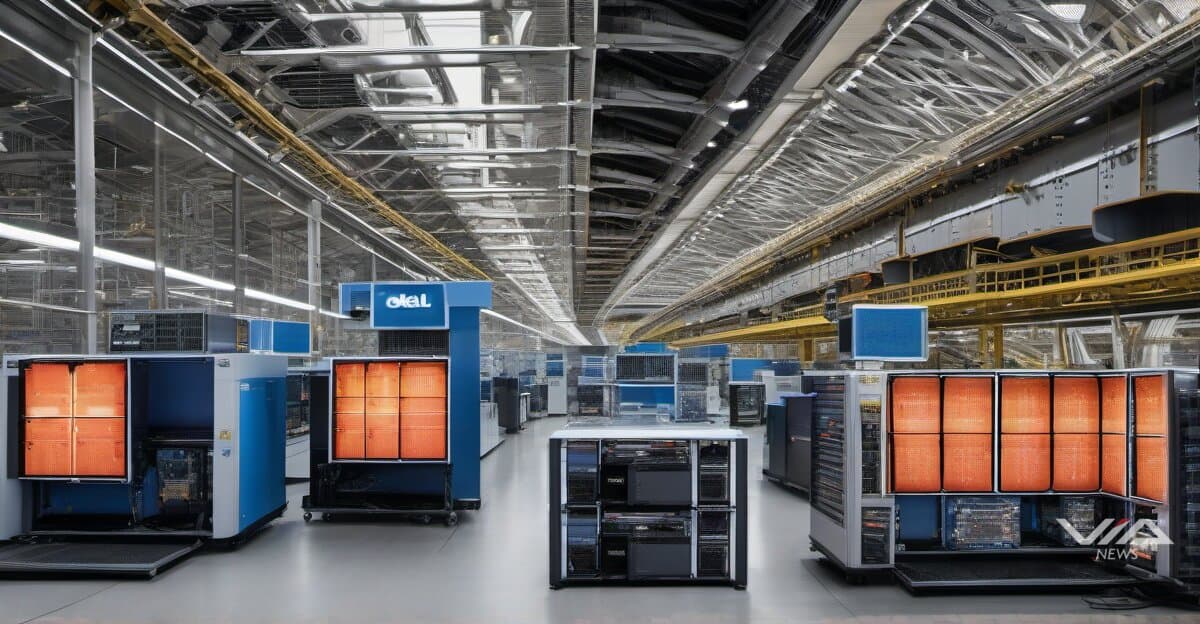
Image generated by AI for illustrative purposes. Not actual footage or photography from the reported events.
Loading stream...

Micron and Dell each gained 5% on June 25 while enterprise software and AI services stocks fell, confirming a sector rotation into semiconductor and HPC infrastructure.SanDisk added 4%.1 The Nasdaq Composite fell even as semiconductors rallied — a divergence that rules out broad risk appetite as the driver.

Infrastructure Over Application

Capital is moving from the AI application and software layer into picks-and-shovels hardware. Chips, memory, servers, and storage are gaining. Enterprise software vendors and AI services companies are losing.

The shift reflects a recalibration in how investors price the AI cycle. Early enthusiasm elevated software and services stocks on expectations of fast AI-driven revenue. That thesis is under pressure. Demand for physical infrastructure — chips, memory, compute — keeps growing regardless of which application-layer companies ultimately win.

Winners and Losers

Memory leads the winners: Micron and SanDisk both surged.1 Dell's gains reflect continued enterprise server and HPC demand. KLA benefits as semiconductor equipment spending holds. Penguin Solutions, a high-performance computing infrastructure provider, rose alongside the group.

On the losing side: enterprise software vendors and AI services firms dependent on corporate IT budget cycles. Enterprise spending remains constrained, squeezing companies that monetize AI at the application layer rather than supplying the hardware beneath it.

What Comes Next

The rotation is projected to persist over the next three to six months.1 Semiconductor ETFs and AI data center REITs are positioned to outperform if the trend holds. Fintech AI vendors tied to enterprise spending face continued pressure.

The Nasdaq's decline despite semiconductor strength is the defining signal. This is not a market-wide rally — it is a reallocation within tech. Money is moving from software to silicon, not flowing into the sector broadly.

For traders, the implication is straightforward: hardware-adjacent positions outperform while enterprise software lags until corporate spending cycles improve.

In this story · Knowledge Files

About this analysis

This is a Via News analysis. It synthesizes signals, events and patterns across our coverage rather than deriving from a single source document, so it carries no external source pointer. Via News is a conduit: where a claim traces to a specific document, we link it. How we source

LM Salvado
LM Salvado

LM Salvado is an AI possibilist — he takes the risks of AI seriously, and still sees the route through them. Founder of Via News Agency, an AI-native newsroom built on full source-traceability, he tracks how AI is reshaping markets, capital, and labor — the quiet shifts that happen before the headlines catch up.

What we know · the intelligence behind this page
Live from the substrate
What we're seeing
Obesity and Immunology Readouts, Big Pharma M&A and AI-Designed Drugs Converge Into a Q4 2026 Catalyst Wave
Late-stage data and deal activity are clustering ahead of Q4 2026. Novo Nordisk's CagriSema won Best Abstract at EASD 2026 for its brain and body (fMRI/MRI) data, Lilly showed ADtouch results for EBGLYSS and agreed to buy Merida Biosciences for $2.9B, and Merck's tulisokibart hit its Phase 2b endpoints. A key regulatory catalyst follows: the FDA PDUFA date for the ivonescimab BLA on 2026-11-14. AI-designed rentosertib showing anti-aging effects adds a speculative AI-drug-discovery thread, while QAIAx's microcities trial and QIII pilot (planned 2027-01-01) are peripheral, forecast-only items.
Our read on the data ›
Signals we're tracking
Satellite-Terrestrial Network Integration Acceleration
Increased investment and launches in hybrid satellite-cellular networks across telecom industry; competitive responses from other carriers; regulatory activity around satellite spectrum; expansion of emergency/rural connectivity use cases
Patterns we're watching ›
Where sources disagree
ING Group
Both facts record the same metric (shares_outstanding) for ING Group at the identical observation date (2025-12-31). FACT A states 2,902,437,688 shares; FACT B states 2,902 million shares (2,902,000,000). The difference is 437,688 shares (~0.015%). This is a genuine value conflict, though the discrepancy appears to result from FACT B rounding to the nearest million while FACT A provides the precise count.
We flag conflicts openly ›
Recently verified
✓ Checked against the original source
4,985
facts traced to their source — and we flag the ones that don't hold up.
101 entities tracked4,985 facts checked against source5,351 source documents archived
Query this data → isubstrate.com