
Saturday, August 22, 2026
What we know · the intelligence behind this page
Live from the substrate
What we're seeing
AI Platforms Rush to Establish Content-Authenticity Standards Amid Leadership Shakeups and Sustained Capex
Within days of each other in mid-August 2026, Google, Anthropic, and Spotify moved to formalize AI content watermarking and labeling policies, signaling an industry-wide push toward self-governed provenance standards as generative AI output floods consumer platforms. The shift coincides with executive turnover at OpenAI (Brad Lightcap's departure) and Meta's public AI manifesto, all set against continued heavy AI infrastructure capital expenditure and finance-sector moves (e.g., Wall Street paying for algorithmic edges on social signals) that underscore AI's deepening entanglement with capital markets.
Our read on the data ›
Signals we're tracking
Satellite-Terrestrial Network Integration Acceleration
Increased investment and launches in hybrid satellite-cellular networks across telecom industry; competitive responses from other carriers; regulatory activity around satellite spectrum; expansion of emergency/rural connectivity use cases
Patterns we're watching ›
Where sources disagree
JPMorgan Chase & Co.
Both facts report JPMorgan Chase & Co.'s revenue for the same fiscal period (FY 2025) with the same observation date (2025-12-31), but with different values: $182.447 billion vs. $185 billion. The ~1.4% difference ($2.553 billion) is too large to be explained by rounding alone and represents conflicting data for the identical time period.
We flag conflicts openly ›
Recently verified
Checked against the original source
4,977
facts traced to their source — and we flag the ones that don't hold up.
101 entities tracked4,977 facts checked against source5,242 source documents archived
Work with this data → vianewsagency.com

AMD Secures Double-Digit Billion Dollar Meta Contract as Data Center GPU Share Surges 7%

AMD stock jumped 7% after winning a major data center contract from Meta worth double-digit billions per gigawatt. The deal signals growing hyperscaler preference for AMD's GPUs as cost pressures mount in AI infrastructure buildout, directly challenging NVIDIA's dominance.

AMD Secures Double-Digit Billion Dollar Meta Contract as Data Center GPU Share Surges 7%
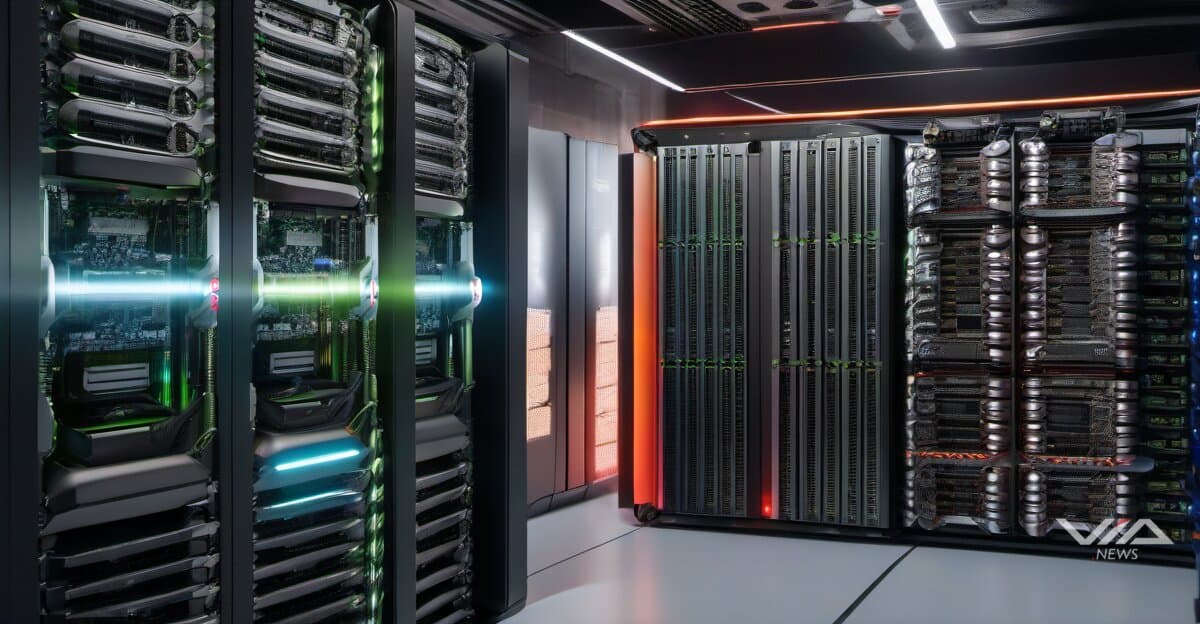
Image generated by AI for illustrative purposes. Not actual footage or photography from the reported events.
Loading stream...

AMD shares rose 7% following Meta's award of a data center GPU contract valued in the double-digit billions per gigawatt, marking a major win in the company's push against NVIDIA in AI infrastructure.

The Meta contract represents AMD's largest hyperscaler deal to date. Cost optimization is driving the shift—AI infrastructure represents the largest buildout in human history with trillions in investment at stake, according to Netris research.

Hyperscalers are diversifying GPU suppliers as deployment costs escalate. AMD's MI300 series offers competitive performance at lower price points than NVIDIA's H100 and upcoming Blackwell chips, creating an opening in price-sensitive segments.

Asia-Pacific deployments are accelerating particularly fast, with VCI Global Limited identifying the region as among the fastest-expanding markets for AI infrastructure. This geographic expansion creates additional opportunities for AMD to capture share before NVIDIA locks in long-term contracts.

AMD's data center GPU revenue grew 117% year-over-year in Q4 2024, though still representing a fraction of NVIDIA's estimated $47B annual data center revenue. The Meta deal could push AMD's quarterly data center GPU revenue above $2B for the first time.

Market analysts see AMD's hypothesis testing in real-time: the next 2-3 quarters will reveal whether this Meta win triggers a cascade of hyperscaler contract announcements. Microsoft, Google, and Amazon remain largely committed to NVIDIA, but budget pressures could shift procurement strategies.

Pricing dynamics favor AMD in specific use cases. Training workloads still favor NVIDIA's CUDA ecosystem and superior interconnect technology. Inference workloads—which dominate deployed AI applications—show less vendor lock-in, giving AMD an entry point.

NVIDIA holds 80-90% market share in data center GPUs for AI workloads. AMD's ability to capture share reflects both the opportunity size and execution risks. Supply chain capacity, software ecosystem maturity, and customer switching costs all limit how quickly AMD can convert interest into revenue.

The semiconductor valuation gap is narrowing. AMD trades at 28x forward earnings versus NVIDIA's 32x, despite NVIDIA's superior margins and market position. If AMD captures even 15-20% of the hyperscaler market over the next two years, current valuations appear conservative.

In this story · Knowledge Files