
Sunday, October 11, 2026

AI Infrastructure Surge: Credo, Aehr, and Ensurge Scale Capacity as Semiconductor Demand Intensifies

Semiconductor infrastructure stocks are issuing bullish forward guidance as AI workload expansion drives urgent capacity buildouts across connectivity, testing, and power systems. With the AI processor market projected to surge from $43.7B to over $323B, companies like Credo Technology, Aehr Test Systems, and Ensurge Micropower are positioning for sustained infrastructure investment despite near-term margin pressure.

AI Infrastructure Surge: Credo, Aehr, and Ensurge Scale Capacity as Semiconductor Demand Intensifies
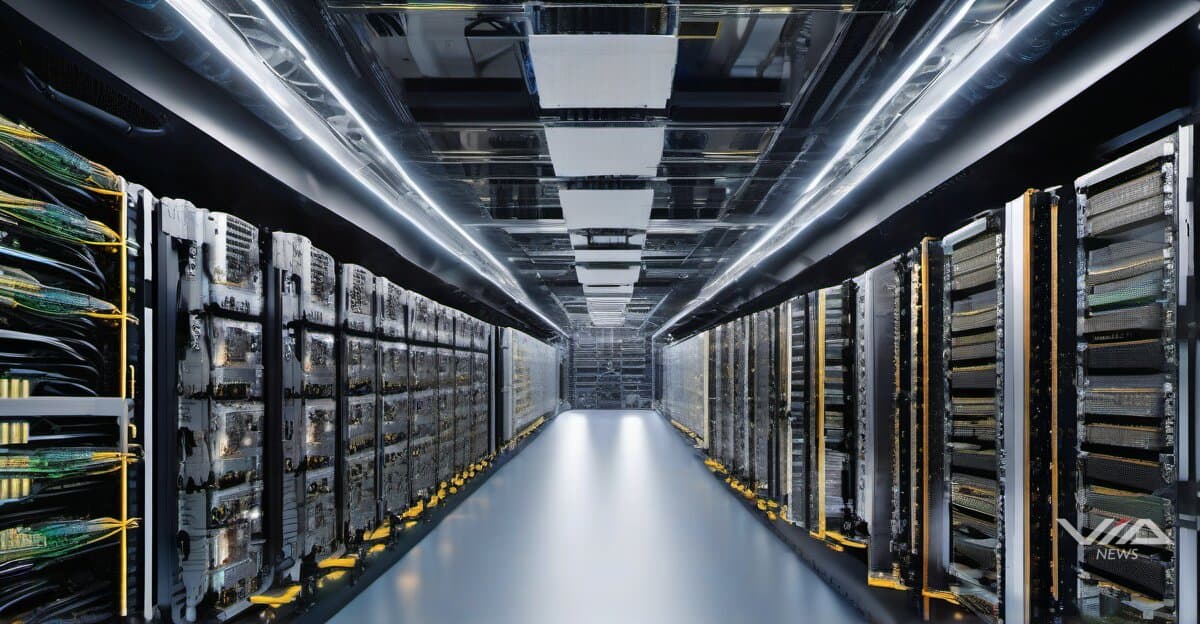
Image generated by AI for illustrative purposes. Not actual footage or photography from the reported events.
Loading stream...

The AI hardware infrastructure race is accelerating across multiple semiconductor layers, with specialty players posting aggressive capacity expansion plans and forward guidance that signals sustained investment cycles through 2027.

Credo Technology, a key player in data center connectivity, is guiding GAAP gross margins between 63.8% and 65.8% for Q3 FY2026—a notably healthy range that reflects strong demand for high-bandwidth interconnect solutions critical to AI cluster buildouts. As hyperscalers deploy increasingly dense GPU configurations, connectivity bottlenecks have emerged as a primary constraint, positioning Credo's solutions at a strategic chokepoint in the infrastructure stack.

Aehr Test Systems reported more challenging near-term financials but delivered bullish long-term signals. Q2 FY2026 revenue fell 27% year-over-year to $9.9M, with non-GAAP gross margin compressing to 29.8% from 45.3% due to lower WaferPak volumes and unfavorable product mix. However, the company raised $10M through an ATM offering and guided second-half FY2026 bookings to $60M-$80M, driven primarily by AI wafer-level and packaged-part burn-in demand.

The critical development: Aehr's lead Sonoma production customer provided a "very large forecast" for AI ASIC testing, with shipments expected to commence in Q1 FY2027. Post-quarter bookings reached $6.5M in just six weeks, pushing effective backlog to $18.3M. CEO Gayn Erickson emphasized production capacity exceeding 20 systems per month for both wafer and package-level testing—infrastructure designed to support the industry's shift toward high-power AI chips requiring up to 2,000 watts per device.

The company's partnership expansion with ISE Labs and ASE for wafer-level and packaged-part testing services targeting "top-tier semiconductor customers" in HPC and AI applications underscores the ecosystem's maturation. As AI chip complexity escalates, testing and burn-in capacity represents an often-overlooked bottleneck that could constrain production ramps.

Ensurge Micropower rounds out the infrastructure buildout narrative on the power management front, addressing edge compute and IoT requirements that complement centralized AI data center investments. While less prominently featured in earnings releases, the company's inclusion in the AI hardware ecosystem signals growing recognition that power efficiency innovations will prove critical as AI workloads proliferate beyond hyperscale facilities.

Market Context and Competitive Dynamics

The infrastructure push occurs against a backdrop of explosive projected growth: the AI processor market is forecast to expand from $43.7B to over $323B, a trajectory that demands parallel investment across the entire supply chain. Google's custom silicon strategy and emerging alternatives signal that Nvidia's dominance faces increasingly targeted challenges, particularly in specialized workload optimization and total-cost-of-ownership considerations.

Critical bottlenecks around the "memory wall"—the gap between processor speed and memory bandwidth—and advanced packaging technologies are defining the next competitive frontier. Companies solving these constraints, whether through high-bandwidth memory integration, advanced interconnects, or thermal management innovations, stand to capture disproportionate value.

For investors, the near-term margin compression at companies like Aehr reflects typical capacity expansion dynamics: short-term profitability sacrifice in exchange for positioning in a rapidly scaling market. The $60M-$80M bookings guidance against $9.9M quarterly revenue illustrates the dramatic demand inflection these companies anticipate.

The infrastructure layer—often overshadowed by headline GPU announcements—may prove the more durable investment theme as AI deployment matures from proof-of-concept to production scale.

Source documents

Via News is a conduit. We point to the source documents behind this report — we don't replace them. Trace any claim to its source and decide what to trust. How we source

Source Trace Score7 source documents7 with a live linkVerifiability: High
  1. [1]Earnings callNasdaq· January 16, 2026
    Aehr Test (AEHR) Q2 2026 Earnings Call Transcript
  2. [2]News articleYahoo Finance· December 1, 2025
    Credo Technology Group Holding Ltd Reports Second Quarter of Fiscal Year 2026 Financial Results
  3. [3]News articleYahoo Finance· February 10, 2026
    Einride to Appoint Former NVIDIA Executive Gary Hicok to Board of Directors
  4. [4]Press releaseGlobeNewswire· November 6, 2025
    Ensurge Micropower ASA – Contemplated private placement
  5. [5]News articleYahoo Finance· December 5, 2025
    Stock market today: S&P 500, Nasdaq, Dow rise as Fed-favored PCE inflation data cools
  6. [6]News articleYahoo Finance· February 17, 2026
    Stock market today: Dow, S&P 500, Nasdaq end higher in volatile trading day as Apple jumps
  7. [7]Press releaseGlobeNewswire· December 11, 2025
    Wafer Dicing Services Market Set to Exceed US$ 932.9 Million by 2035 | Astute Analytica

In this story · Knowledge Files

What we know · the intelligence behind this page
Live from the substrate
What we're seeing
Agentic AI Rewires Enterprise Software: Platform Incumbents, Governance, and a Funded Startup Wave
Enterprise software is being rebuilt around autonomous AI agents. Incumbents and large platforms (SAP with its Autonomous Suite and Joule, Zeta with AthenaOS/AIM/Athena MCP, Meta with its new Enterprise Platform) are racing to own the agent layer. Meanwhile, seed and Series A money flows to finance-office and vertical startups (Dextr, Latitude, Dentira, Light), and consolidation continues through acquisitions (Tiny–Oso Cloud, Harvey–Guardrails AI). Investor commentary stresses that AI is better at disrupting around the edges of systems of record than at replacing them, that it should not be trusted with finance calculations, and that governance must be enforced by the system rather than left to agents.
Our read on the data ›
Signals we're tracking
EPKINLY Regulatory-Clinical Success Cascade
High probability of expanded label indications, additional combination approvals, and competitive positioning strength in follicular lymphoma market. Predicts positive commercial uptake and potential accelerated review for related indications.
Patterns we're watching ›
Where sources disagree
ING Group
Both facts record the same metric (shares_outstanding) for ING Group at the identical observation date (2025-12-31). FACT A states 2,902,437,688 shares; FACT B states 2,902 million shares (2,902,000,000). The difference is 437,688 shares (~0.015%). This is a genuine value conflict, though the discrepancy appears to result from FACT B rounding to the nearest million while FACT A provides the precise count.
We flag conflicts openly ›
Recently verified
✓ Checked against the original source
4,986
facts traced to their source — and we flag the ones that don't hold up.
101 entities tracked4,986 facts checked against source5,369 source documents archived
Query this data → isubstrate.com