
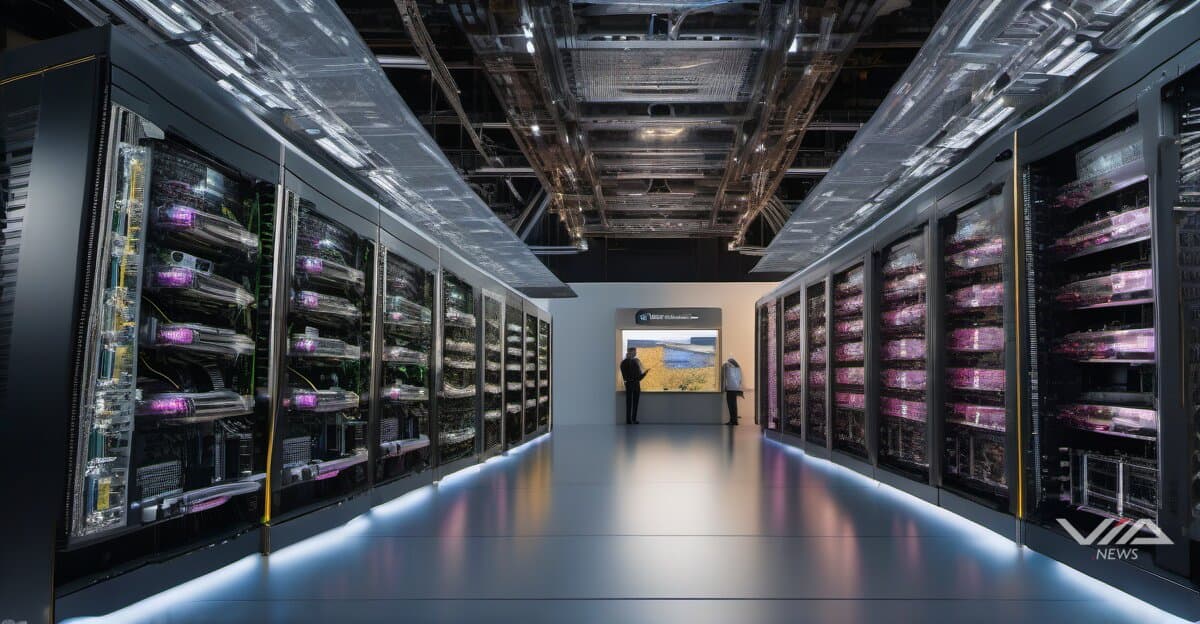
Nvidia has committed $4 billion to photonics integration investments as the semiconductor industry confronts power consumption challenges in AI computing infrastructure. The capital deployment signals a strategic shift from traditional electronic architectures to optical solutions that promise order-of-magnitude efficiency gains.
The AI hardware transformation extends beyond Nvidia's photonics push. InspireSemi is developing accelerated computing platforms for high-performance computing and AI workloads, competing directly with established architectures. Apple and Samsung continue advancing next-generation chip designs to capture datacenter market share.
Power efficiency has emerged as the critical battleground. Wolfspeed supplies silicon carbide semiconductors for high-voltage EV power systems, supporting Toyota's electric vehicle platforms through direct OEM relationships and Tier 1 partnerships. The technology addresses power conversion losses that plague current battery-electric architectures.
Gallium nitride semiconductors represent another efficiency vector, delivering superior power density compared to legacy silicon solutions. STMicroelectronics launched its complete Aliro 1.0 connectivity portfolio, spanning NFC-only configurations through combined NFC, Bluetooth Low Energy, and ultra-wideband implementations for hands-free access systems.
Credo Technology has developed Active Electrical Cables (AECs) targeting interconnect bottlenecks in AI server racks. The solutions address signal integrity degradation and power consumption in high-speed data transmission between GPUs and accelerators.
Lattice Semiconductor forecast Q1 revenue between $158 million and $172 million, reflecting broader industry demand patterns. The programmable logic specialist competes in edge AI applications where power budgets constrain deployment options.
The convergence of photonics, advanced power semiconductors, and specialized accelerators indicates an architecture transition comparable to prior platform shifts. Companies executing on power efficiency will capture disproportionate value as AI workloads migrate from experimental deployments to production infrastructure at scale.
Market expansion depends on solving the energy equation. Current AI training clusters consume megawatts, creating operational constraints that limit deployment density. Technologies reducing watts-per-operation by 50-90% will unlock addressable markets currently blocked by power availability and cooling capacity.