
Saturday, September 19, 2026

Photonic Chip Startup Olix Targets 2027 Launch Amid $110B AI Infrastructure Wave

Olix plans to ship its first photonic chip product in 2027, entering a market reshaped by massive AI capital deployment. OpenAI's $110B funding round and Anthropic's $30B raise signal investor confidence in specialized AI silicon beyond traditional GPUs. Emerging players are pursuing photonic and domain-specific architectures as the semiconductor industry adapts to AI workload demands.

LM Salvado
LM Salvado

March 16, 2026

Photonic Chip Startup Olix Targets 2027 Launch Amid $110B AI Infrastructure Wave
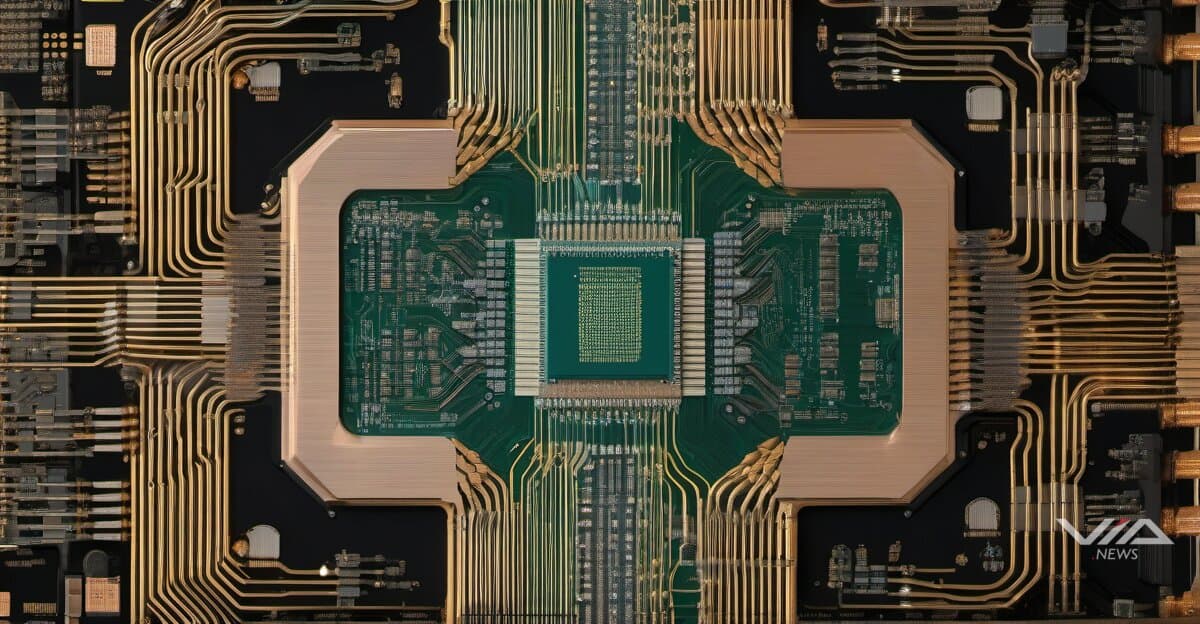
Image generated by AI for illustrative purposes. Not actual footage or photography from the reported events.
Loading stream...

Olix has set a 2027 target for its first photonic chip product, positioning itself in an AI semiconductor market attracting record capital flows.

The startup's timeline coincides with major AI infrastructure investments. OpenAI secured $110B in funding while Anthropic raised $30B, both rounds signaling institutional backing for next-generation AI hardware ecosystems. MatX added $500M to develop AI-optimized chip architectures.

Photonic chips use light instead of electricity for data transmission, potentially offering speed and power efficiency advantages for AI workloads. The technology represents an alternative to conventional GPU and TPU designs that currently dominate AI training and inference.

Nio's subsidiary GeniTech is pursuing specialized chips for autonomous driving applications. The emergence of domain-specific players challenges the one-size-fits-all approach of general-purpose AI accelerators.

Tooling providers are adapting to diversified chip architectures. Synopsys released OptoCompiler for photonic circuit design, while its VC Functional Safety Manager targets automotive-grade silicon verification. These tools reduce barriers for companies developing specialized AI chips.

Canada's CFI committed $552M to research infrastructure supporting semiconductor development, reflecting government recognition of strategic importance. Public funding complements private capital in building capabilities beyond established players.

The capital concentration in AI has created urgency around chip performance bottlenecks. Training frontier models requires massive compute capacity, driving demand for architectures optimized for transformer networks and other AI-specific workloads.

Traditional semiconductor firms face competition from vertical integration. Major AI companies are designing custom chips to control their technology stacks and reduce dependence on third-party suppliers.

Olix's 2027 product launch will enter a market testing whether photonic technology can deliver commercial advantages at scale. The company faces execution risks typical of hardware startups: manufacturing partnerships, yield optimization, and customer validation.

Investment in specialized AI chips reflects a bet that workload diversity will reward purpose-built architectures over general-purpose solutions. The next two years will determine which approaches gain market traction as products ship and performance claims meet real-world testing.

Source documents

Via News is a conduit. We point to the source documents behind this report — we don't replace them. Trace any claim to its source and decide what to trust. How we source

Source Trace Score5 source documents5 with a live linkVerifiability: Strong
  1. [1]News articleCrunchbase News
    While OpenAI Shattered Records, Robotics and Semiconductor Startups Quietly Added The Most New Unicorns In February
  2. [2]Press releaseGlobeNewswire· March 13, 2026
    D’importants investissements dans l'infrastructure de recherche placent le Canada en tête de l'innovation mondiale
  3. [3]Press releaseGlobeNewswire· February 9, 2026
    Hyperscale Data Centers Market Set to Reach US$ 177.58 Billion by 2032 | AI Workloads and Cloud Expansion Reshape Global Infrastructure Says Astute Analytica
  4. [4]Press releaseGlobeNewswire· February 2, 2026
    Laser Cutting Machine Market to Hit USD 12.3Bn by 2031 Growing at 9.55% CAGR: Mordor Intelligence
  5. [5]News articleYahoo Finance· March 11, 2026
    Synopsys Launches Ansys 2026 R1 to Re-Engineer Engineering with Joint Solutions and AI-Powered Products

In this story · Knowledge Files

LM Salvado
LM Salvado

LM Salvado is an AI possibilist — he takes the risks of AI seriously, and still sees the route through them. Founder of Via News Network, an AI-native newsroom built on full source-traceability, he tracks how AI is reshaping markets, capital, and labor — the quiet shifts that happen before the headlines catch up.

What we know · the intelligence behind this page
Live from the substrate
What we're seeing
AI Boom Hits a Fork: Slowdown Calls Clash with Capex Confidence as Markets Get Nervous
Dario Amodei's repeated calls for a global slowdown in frontier AI development, echoed by Microsoft's new humanist AI code of conduct and FTC antitrust caution, are being publicly rejected by Nvidia and Meta leadership even as hyperscaler spending draws fresh skeptical scrutiny (Wachter's analysis, Burry-style overbuilding worries) and weak guidance from Adobe and a post-slowdown-comment selloff in GE Vernova signal investor jitters. Meanwhile wealth and security effects of the AI race keep compounding — Zhang Yiming's fortune surging on AI-driven ByteDance value, a Chinese hacking firm weaponizing AI against stolen government secrets, and low-quality AI-generated products (an AI sitcom, a spam-flooding agent platform) fueling backlash even as adoption races ahead.
Our read on the data ›
Signals we're tracking
EPKINLY Regulatory-Clinical Success Cascade
High probability of expanded label indications, additional combination approvals, and competitive positioning strength in follicular lymphoma market. Predicts positive commercial uptake and potential accelerated review for related indications.
Patterns we're watching ›
Where sources disagree
Berkshire Hathaway
Both facts report Berkshire Hathaway's cash position on 2026-01-01 with identical observation timestamps, but claim vastly different values: 380 billion USD vs 400 USD. These cannot both be true for the same entity at the same point in time. The magnitude of the discrepancy (a factor of ~10^9) rules out rounding, unit conversion, or methodological differences.
We flag conflicts openly ›
Recently verified
Checked against the original source
4,982
facts traced to their source — and we flag the ones that don't hold up.
101 entities tracked4,982 facts checked against source5,299 source documents archived
Query this data → isubstrate.com