
Saturday, August 22, 2026
What we know · the intelligence behind this page
Live from the substrate
What we're seeing
AI Platforms Rush to Establish Content-Authenticity Standards Amid Leadership Shakeups and Sustained Capex
Within days of each other in mid-August 2026, Google, Anthropic, and Spotify moved to formalize AI content watermarking and labeling policies, signaling an industry-wide push toward self-governed provenance standards as generative AI output floods consumer platforms. The shift coincides with executive turnover at OpenAI (Brad Lightcap's departure) and Meta's public AI manifesto, all set against continued heavy AI infrastructure capital expenditure and finance-sector moves (e.g., Wall Street paying for algorithmic edges on social signals) that underscore AI's deepening entanglement with capital markets.
Our read on the data ›
Signals we're tracking
Satellite-Terrestrial Network Integration Acceleration
Increased investment and launches in hybrid satellite-cellular networks across telecom industry; competitive responses from other carriers; regulatory activity around satellite spectrum; expansion of emergency/rural connectivity use cases
Patterns we're watching ›
Where sources disagree
JPMorgan Chase & Co.
Both facts report JPMorgan Chase & Co.'s revenue for the same fiscal period (FY 2025) with the same observation date (2025-12-31), but with different values: $182.447 billion vs. $185 billion. The ~1.4% difference ($2.553 billion) is too large to be explained by rounding alone and represents conflicting data for the identical time period.
We flag conflicts openly ›
Recently verified
Checked against the original source
4,977
facts traced to their source — and we flag the ones that don't hold up.
101 entities tracked4,977 facts checked against source5,242 source documents archived
Work with this data → vianewsagency.com

Nvidia Halts H200 Chip Production as Export Controls Fracture AI Hardware Supply Chain

The Trump administration's GPU export controls forced Nvidia to halt H200 chip production targeting China, while Anthropic faces supply chain risk designation despite $10B Nvidia investment. The regulatory crackdown coincides with OpenAI's robotics chief departing over Pentagon deals and Oracle canceling data center expansion plans.

Nvidia Halts H200 Chip Production as Export Controls Fracture AI Hardware Supply Chain
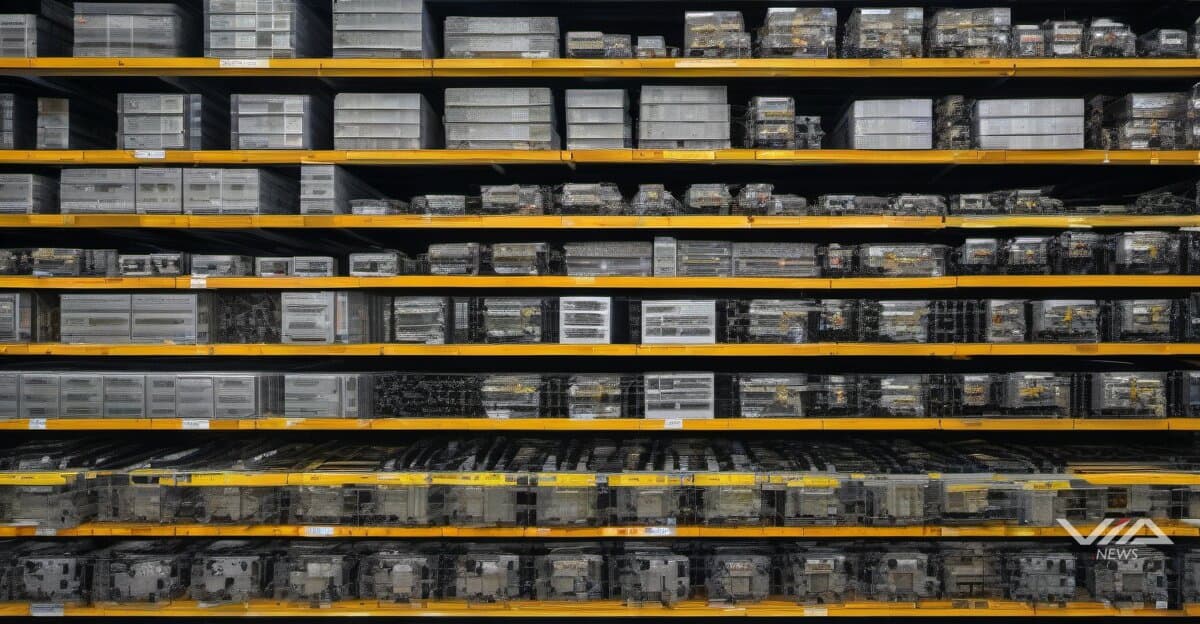
Image generated by AI for illustrative purposes. Not actual footage or photography from the reported events.
Loading stream...

Nvidia suspended H200 GPU production under new export controls targeting China, marking the sharpest regulatory intervention in AI hardware markets. The Trump administration is considering a permitting process that could allow selective shipments, but immediate production halts signal supply chain disruption for companies dependent on advanced AI chips.

Anthropic received a supply chain risk designation from U.S. officials despite securing $10B in Nvidia investment. The AI company resumed Pentagon contract negotiations after the designation, highlighting the collision between commercial AI infrastructure and national security priorities. This designation creates uncertainty for institutional investors holding positions in AI infrastructure plays.

OpenAI's robotics division head resigned over disagreements on Pentagon partnerships, following the company's cancellation of Oracle data center expansion. The Oracle deal termination removes a major cloud infrastructure buildout that was expected to support OpenAI's scaling ambitions. These organizational shifts suggest internal friction over defense contracting is reshaping AI company strategies.

The export control framework creates bifurcated markets: domestic AI hardware development versus restricted international sales. Nvidia faces revenue concentration risk if Chinese demand evaporates without replacement markets. Chip designers may need to develop export-compliant architectures, adding development costs and potentially fragmenting product lines.

Supply chain fragmentation pressures valuations across the AI hardware stack. Companies with diversified geographic revenue face less regulatory risk than China-dependent suppliers. Defense contractors gain positioning as AI companies pivot toward Pentagon relationships, potentially creating new winners in military AI infrastructure.

The regulatory environment favors domestic chip production and cloud providers with U.S.-only operations. Investors should monitor permitting process details, as selective export allowances could preserve portions of Nvidia's China revenue. Near-term volatility is likely until clarity emerges on which companies qualify for exemptions and how enforcement mechanisms function in practice.

Source documents

Via News is a conduit. We point to the source documents behind this report — we don't replace them. Trace any claim to its source and decide what to trust. How we source

Source Trace Score1 source document1 with a live linkVerifiability: Basic
  1. [1]News articleYahoo Finance· March 9, 2026
    Tech stocks today: OpenAI's robotics leader resigns after Pentagon deal, Anthropic prepares to battle ban

In this story · Knowledge Files