
Sunday, October 11, 2026

TSMC Capex Hike Signals AI Chip Rush as Marvell Eyes $2B Celestial AI Deal

Taiwan Semiconductor raised 2026 capex guidance as AI chip demand accelerates, while Marvell entered talks to acquire optical interconnect firm Celestial AI for roughly $2 billion. Intel committed new Malaysia fab investment and Infineon continues Dresden expansion, pointing to synchronized betting on AI infrastructure buildout across the chip sector.

TSMC Capex Hike Signals AI Chip Rush as Marvell Eyes $2B Celestial AI Deal
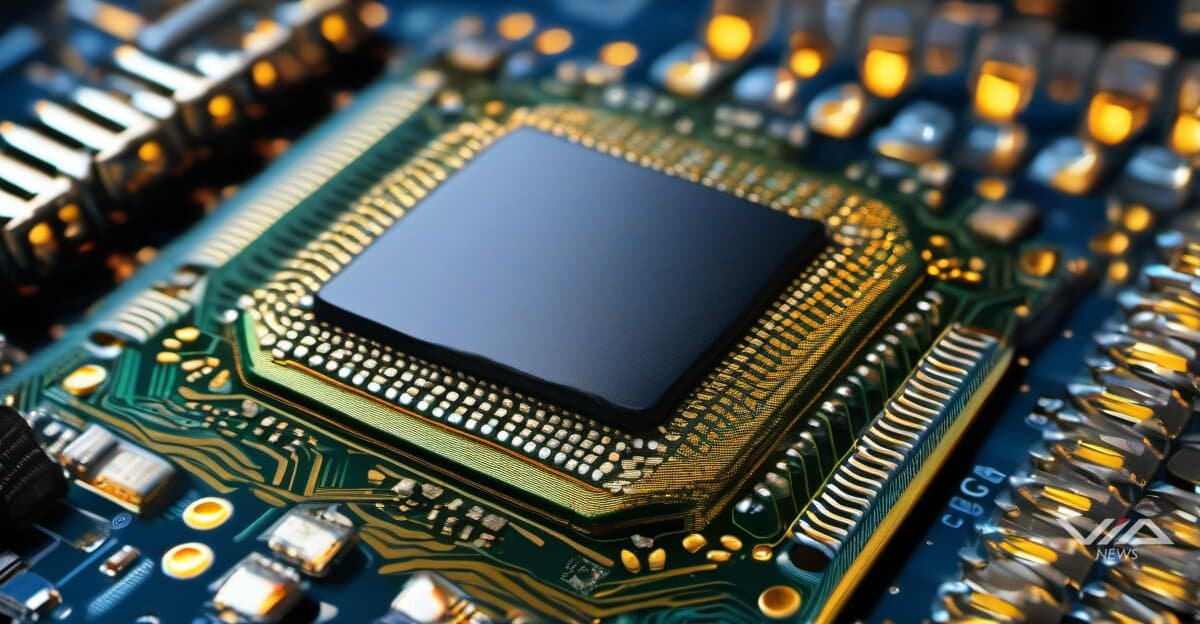
Image generated by AI for illustrative purposes. Not actual footage or photography from the reported events.
Loading stream...

Taiwan Semiconductor Manufacturing Company increased its capital expenditure guidance for 2026 on January 1st, marking the latest in a wave of chipmaker spending tied to artificial intelligence infrastructure. The move follows Marvell Technology's December 3rd entry into acquisition talks with Celestial AI, a specialist in optical interconnect technology for AI data centers, with deal values reported near $2 billion.

The pattern extends beyond leading-edge logic. Intel announced fresh fab investment in Malaysia on December 3rd, while Infineon Technologies reported final funding approval and ongoing construction for its Dresden facility. Microchip Technology cited "broad-based recovery in most end markets" in revised net sales guidance, suggesting capex cycles are broadening beyond pure AI plays.

Optical interconnects like those Celestial AI develops address a bottleneck in AI training clusters: moving data between chips faster than traditional copper connections allow. Marvell already supplies custom silicon for cloud hyperscalers, making the Celestial AI acquisition a vertical integration play into connectivity IP. The deal would value Celestial AI at roughly 30x estimated 2025 revenue, premium pricing that reflects scarcity of proven AI interconnect technology.

TSMC's capex increase carries weight as a demand signal. The foundry sees orders 18-24 months ahead of production, giving it visibility into customer chip plans. Higher spending typically precedes capacity additions for 3nm and smaller nodes used in AI accelerators from Nvidia, AMD, and custom hyperscaler designs.

Infineon's Dresden facility targets power semiconductors and analog chips for automotive and industrial applications, not AI directly. Its simultaneous expansion alongside AI-focused capex suggests chip executives expect AI-driven economic activity to lift adjacent markets, not just data center components.

The convergence of foundry spending, specialty fab buildouts, and M&A in AI connectivity creates a testable thesis: optical and high-speed interconnect acquisitions should track quarterly capex growth at TSMC, Intel, and Infineon with 6-12 month lag. If AI chip revenue growth stalls, connectivity deals would likely freeze first as lower-volume components with longer payback periods.

Investors face a timing question. Current capex peaks in late 2026 or early 2027 based on construction schedules, but AI chip revenue must grow enough through 2027-2028 to justify the installed capacity. Optical interconnect M&A prices in that growth already.

In this story · Knowledge Files

What we know · the intelligence behind this page
Live from the substrate
What we're seeing
Agentic AI Rewires Enterprise Software: Platform Incumbents, Governance, and a Funded Startup Wave
Enterprise software is being rebuilt around autonomous AI agents. Incumbents and large platforms (SAP with its Autonomous Suite and Joule, Zeta with AthenaOS/AIM/Athena MCP, Meta with its new Enterprise Platform) are racing to own the agent layer. Meanwhile, seed and Series A money flows to finance-office and vertical startups (Dextr, Latitude, Dentira, Light), and consolidation continues through acquisitions (Tiny–Oso Cloud, Harvey–Guardrails AI). Investor commentary stresses that AI is better at disrupting around the edges of systems of record than at replacing them, that it should not be trusted with finance calculations, and that governance must be enforced by the system rather than left to agents.
Our read on the data ›
Signals we're tracking
EPKINLY Regulatory-Clinical Success Cascade
High probability of expanded label indications, additional combination approvals, and competitive positioning strength in follicular lymphoma market. Predicts positive commercial uptake and potential accelerated review for related indications.
Patterns we're watching ›
Where sources disagree
ING Group
Both facts record the same metric (shares_outstanding) for ING Group at the identical observation date (2025-12-31). FACT A states 2,902,437,688 shares; FACT B states 2,902 million shares (2,902,000,000). The difference is 437,688 shares (~0.015%). This is a genuine value conflict, though the discrepancy appears to result from FACT B rounding to the nearest million while FACT A provides the precise count.
We flag conflicts openly ›
Recently verified
✓ Checked against the original source
4,986
facts traced to their source — and we flag the ones that don't hold up.
101 entities tracked4,986 facts checked against source5,369 source documents archived
Query this data → isubstrate.com