
Sunday, October 11, 2026

Amkor's 750,000 sq ft Arizona chip plant targets 2028 production start

Amkor Technology plans to begin production at its Arizona semiconductor packaging facility in January 2028, featuring 750,000 square feet of cleanroom space. The expansion addresses growing domestic demand for advanced packaging services as chipmakers relocate production stateside. The facility will serve customers requiring high-volume packaging capacity outside Asia's traditional manufacturing hubs.

Amkor's 750,000 sq ft Arizona chip plant targets 2028 production start
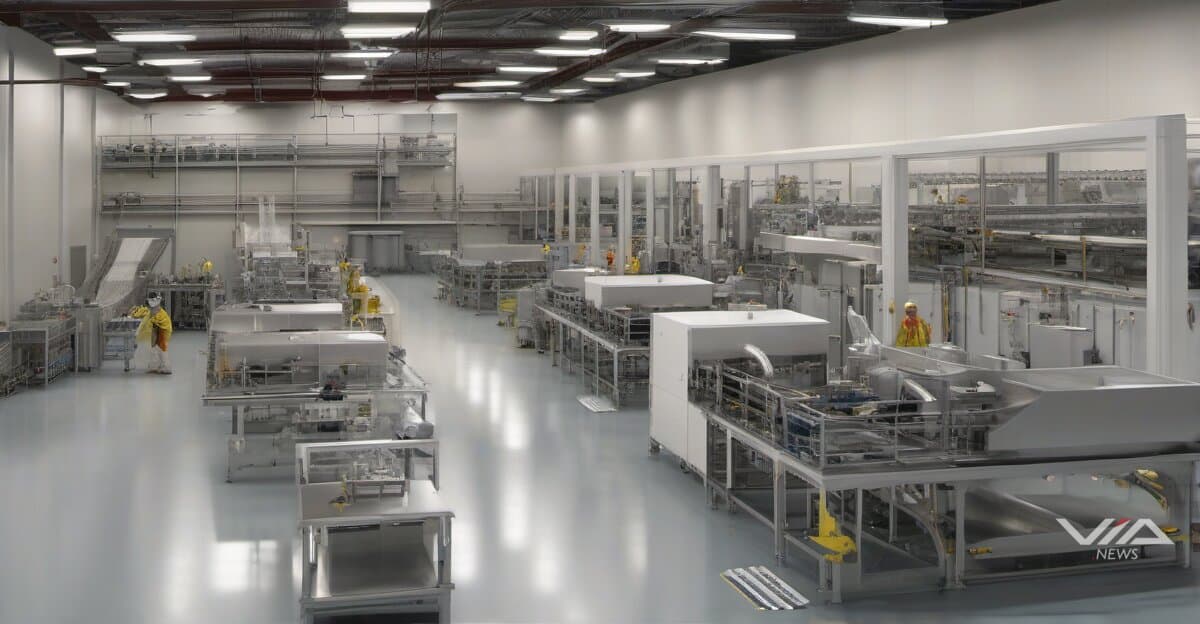
Image generated by AI for illustrative purposes. Not actual footage or photography from the reported events.
Loading stream...

Amkor Technology's Arizona campus is scheduled to start production in January 2028 with 750,000 square feet of cleanroom capacity for semiconductor packaging operations.

The facility expands US-based advanced packaging infrastructure as companies diversify supply chains away from Taiwan and South Korea. Amkor operates as a contracted packaging provider for fabless chip designers and integrated device manufacturers requiring assembly, test, and packaging services.

Advanced packaging—stacking chips vertically or placing them side-by-side—has become critical for AI accelerators, data center processors, and mobile chips. TSMC, Intel, and Samsung compete in this segment, but outsourced assembly and test services (OSAT) providers like Amkor handle significant production volume.

The Arizona buildout follows CHIPS Act incentives promoting domestic semiconductor production. Apple's commitment to source US-packaged chips from the facility signals customer demand for stateside capacity. The plant will likely support mobile processors, automotive chips, and potentially AI hardware requiring domestic assembly.

Amkor's largest facilities remain in South Korea, Taiwan, and China, where established infrastructure and skilled labor pools offer cost advantages. The Arizona campus represents geographic hedging rather than wholesale relocation.

The 2028 timeline aligns with TSMC's Arizona fab ramp and Intel's Ohio facility plans. Coordinated domestic capacity across wafer fabrication and packaging reduces logistics complexity for customers prioritizing supply chain resilience.

Cleanroom square footage indicates capital intensity. Packaging facilities require controlled environments similar to wafer fabs, though less stringent. The 750,000 sq ft footprint suggests high-volume production capability competitive with Asian sites.

Semiconductor equipment suppliers like Disco Corporation and TOWA Corporation provide dicing saws, molding systems, and test handlers for packaging lines. US facility launches typically drive equipment orders 18-24 months before production starts, supporting capital equipment makers.

The plant's success depends on customer willingness to absorb higher US manufacturing costs versus Asian alternatives. Premium pricing for domestic packaging requires customers valuing supply security over cost optimization.

Source documents

Via News is a conduit. We point to the source documents behind this report — we don't replace them. Trace any claim to its source and decide what to trust. How we source

Source Trace Score1 source document1 with a live linkVerifiability: Basic
  1. [1]Press releaseGlobeNewswire· December 11, 2025
    Wafer Dicing Services Market Set to Exceed US$ 932.9 Million by 2035 | Astute Analytica

In this story · Knowledge Files

What we know · the intelligence behind this page
Live from the substrate
What we're seeing
Agentic AI Rewires Enterprise Software: Platform Incumbents, Governance, and a Funded Startup Wave
Enterprise software is being rebuilt around autonomous AI agents. Incumbents and large platforms (SAP with its Autonomous Suite and Joule, Zeta with AthenaOS/AIM/Athena MCP, Meta with its new Enterprise Platform) are racing to own the agent layer. Meanwhile, seed and Series A money flows to finance-office and vertical startups (Dextr, Latitude, Dentira, Light), and consolidation continues through acquisitions (Tiny–Oso Cloud, Harvey–Guardrails AI). Investor commentary stresses that AI is better at disrupting around the edges of systems of record than at replacing them, that it should not be trusted with finance calculations, and that governance must be enforced by the system rather than left to agents.
Our read on the data ›
Signals we're tracking
EPKINLY Regulatory-Clinical Success Cascade
High probability of expanded label indications, additional combination approvals, and competitive positioning strength in follicular lymphoma market. Predicts positive commercial uptake and potential accelerated review for related indications.
Patterns we're watching ›
Where sources disagree
ING Group
Both facts record the same metric (shares_outstanding) for ING Group at the identical observation date (2025-12-31). FACT A states 2,902,437,688 shares; FACT B states 2,902 million shares (2,902,000,000). The difference is 437,688 shares (~0.015%). This is a genuine value conflict, though the discrepancy appears to result from FACT B rounding to the nearest million while FACT A provides the precise count.
We flag conflicts openly ›
Recently verified
✓ Checked against the original source
4,986
facts traced to their source — and we flag the ones that don't hold up.
101 entities tracked4,986 facts checked against source5,369 source documents archived
Query this data → isubstrate.com