
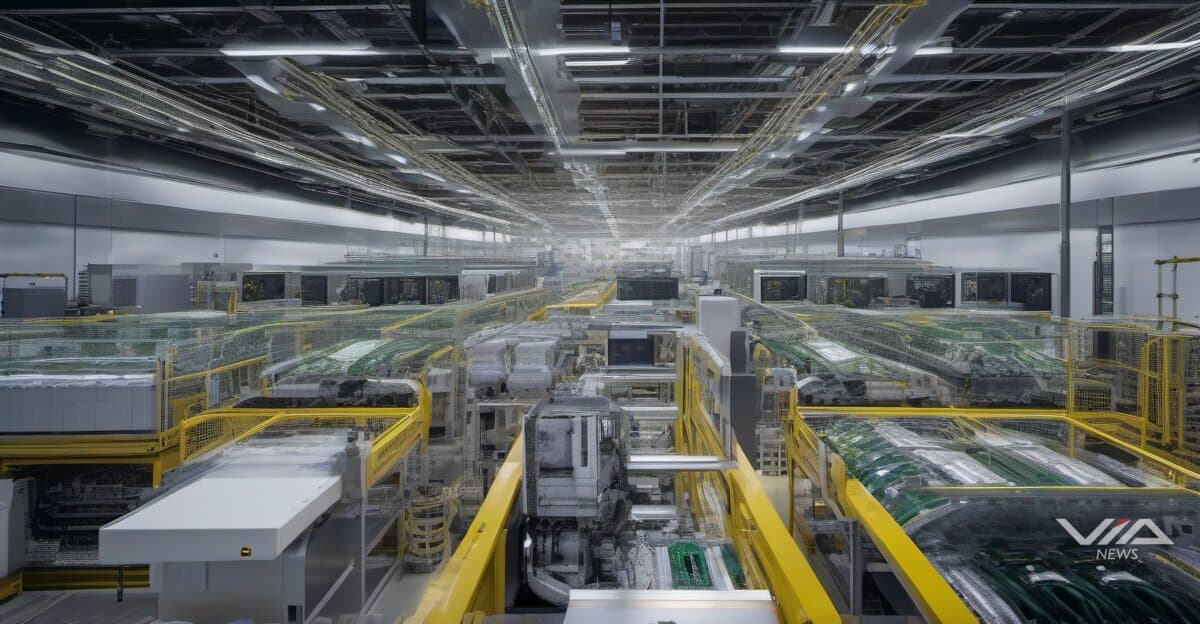
Nvidia announced $4 billion in silicon photonics investments through partnerships with Coherent and Lumentum, marking a strategic pivot toward advanced interconnect technologies for AI infrastructure. The move addresses bandwidth bottlenecks in AI compute systems that copper and traditional optical solutions cannot resolve at scale.
Analog Devices cited strong demand from industrial and data center customers as AI continues to drive semiconductor sales. The company's performance reflects broader sector momentum as data center buildouts require specialized chips beyond GPUs.
Lattice Semiconductor provided Q1 revenue guidance of $158 million to $172 million, supported by demand across its programmable logic portfolio. Memory and specialty chipmakers are experiencing similar tailwinds as hyperscalers expand AI training and inference capacity.
Silicon photonics uses light instead of electrons to move data between chips, enabling higher bandwidth and lower power consumption than electrical interconnects. Nvidia's investment scale suggests the technology is moving from research to production deployment in next-generation AI systems.
SiTime Corporation announced its acquisition of Renesas' timing business will be accretive to non-GAAP earnings per share in the first year post-close. Timing solutions are critical components in data center infrastructure, where synchronization requirements increase with system complexity.
The Connectivity Standards Alliance released Aliro 1.0, a unified access control standard supported by STMicroelectronics and Nordic Semiconductor. STMicroelectronics offers complete secure connectivity portfolios supporting NFC, Bluetooth Low Energy, and UWB configurations. Nordic's Øyvind Strøm noted that ecosystem alignment on open standards simplifies development and strengthens user trust.
The semiconductor sector transformation extends beyond AI chips to the entire data center stack. Analog components, memory, timing solutions, and connectivity chips are all experiencing demand increases as AI workloads require more sophisticated infrastructure.
Investment implications center on companies positioned across the AI supply chain rather than just GPU manufacturers. Analog chipmakers, memory suppliers, and specialty semiconductor firms are capturing value as data center architectures evolve to support AI at scale. Nvidia's silicon photonics push validates the technology's commercial readiness and signals where infrastructure investment is flowing.