
Thursday, September 10, 2026

Optical Interconnect Orders Surge as AI Datacenters Race to Scale GPU Clusters

Co-packaged optics laser orders are accelerating as AI infrastructure providers bet on optical circuit switching to eliminate GPU communication bottlenecks. The shift addresses bandwidth constraints in training clusters exceeding 100,000 GPUs. Semiconductor suppliers positioned in optical interconnect technology face rising demand as traditional electrical switching hits physical limits.

Optical Interconnect Orders Surge as AI Datacenters Race to Scale GPU Clusters
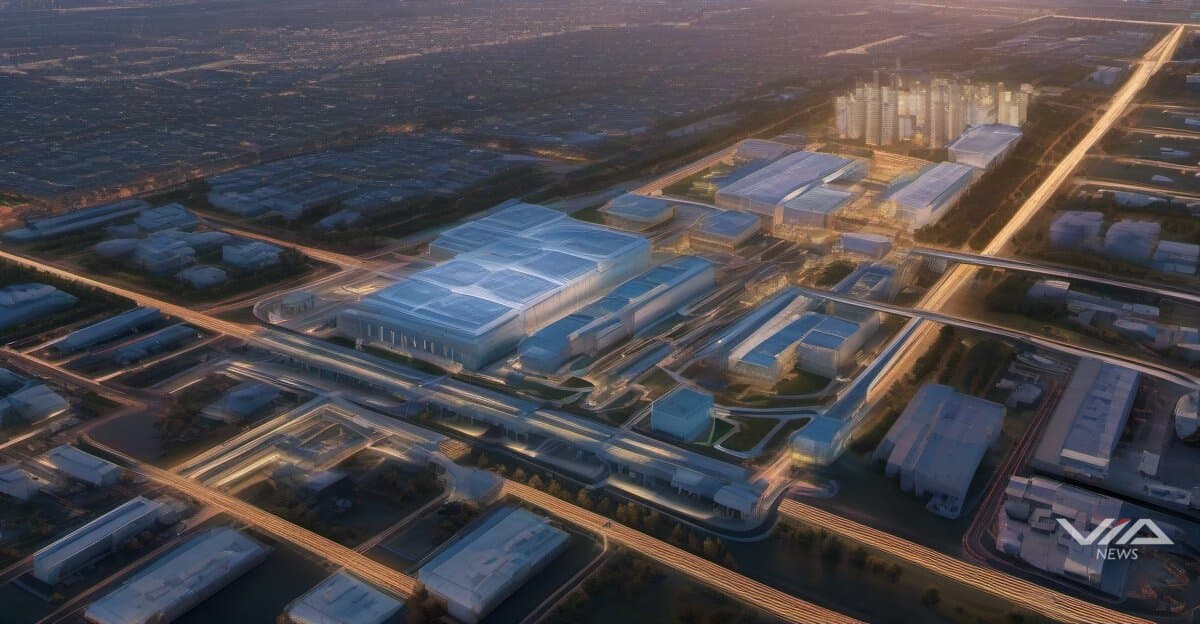
Image generated by AI for illustrative purposes. Not actual footage or photography from the reported events.
Loading stream...

AI datacenter operators are placing substantial purchase orders for co-packaged optics (CPO) lasers as optical circuit switch technology enters commercial deployment. The equipment enables GPU-to-GPU communication at bandwidths unreachable with copper interconnects.

Training clusters now regularly exceed 50,000 GPUs, with frontier AI labs targeting 100,000-GPU systems by late 2026. Each doubling of cluster size increases interconnect complexity exponentially. Optical switching fabrics reduce latency to sub-microsecond levels while supporting 800Gbps to 1.6Tbps per port.

CPO technology integrates laser sources directly onto switch silicon, eliminating signal conversion losses between electrical and optical domains. This approach cuts power consumption by 30-40% compared to pluggable optical modules while increasing port density. Major cloud providers are qualifying CPO designs for 2027 datacenter deployments.

The market shift favors semiconductor companies with silicon photonics capabilities and laser manufacturers specializing in datacom wavelengths. Traditional networking equipment vendors face pressure to adopt optical switching or risk losing datacenter infrastructure contracts.

Inference workloads drive additional demand as AI model serving requires low-latency communication across distributed GPU pools. Companies running real-time AI applications cannot tolerate the 10-100 microsecond delays common in electrical networks at scale.

Industry analysts project optical interconnect adoption will accelerate through 2028 as AI training runs grow to multi-exaflop scale. The technology transition mirrors the 2010s shift from 1GbE to 100GbE datacenter networking, but compressed into a shorter timeframe.

Investors are tracking companies with established silicon photonics foundries, indium phosphide laser production, and optical switch ASIC design expertise. Supply chain constraints for specialized components could create pricing power for early movers.

The optical interconnect buildout represents a multi-billion dollar capital expenditure wave separate from GPU procurement budgets. Datacenter operators are allocating 15-20% of AI infrastructure spending to networking and interconnect systems in 2026, up from 8-10% in 2024.

What we know · the intelligence behind this page
Live from the substrate
What we're seeing
AI Capital Boom Meets Valuation Jitters: Funding Surges While Bellwether Stocks Wobble
A dense wave of AI-sector funding (Socure, Stability AI, Emerald AI, Generalist AI, Gatik, Regent Craft and others closing rounds on the same day) and strong enterprise-automation earnings (UiPath raising full-year guidance) point to continued heavy capital deployment into AI infrastructure, fintech-adjacent AI, and agentic automation. Yet Palantir's stock fell even after winning the Army's high-profile TITAN contract, and commentary (e.g., the Alphabet bull case citing AI capex and regulatory risk) signals growing investor unease about whether current AI valuations and spending levels are sustainable.
Our read on the data ›
Signals we're tracking
Satellite-Terrestrial Network Integration Acceleration
Increased investment and launches in hybrid satellite-cellular networks across telecom industry; competitive responses from other carriers; regulatory activity around satellite spectrum; expansion of emergency/rural connectivity use cases
Patterns we're watching ›
Where sources disagree
JPMorgan Chase & Co.
Both facts represent the same entity (JPMorgan Chase & Co.), same attribute (EPS), and same observation date (2025-12-31), which aligns with FY 2025 year-end reporting. Fact A explicitly states FY 2025 with EPS of 20.02 USD/share. Fact B has an unspecified fiscal period (N/A) but reports 4.63 USD, a significantly different value (4.3x lower). Given identical observation dates and the same metric, both facts appear intended to represent FY 2025 annual EPS. The conflicting values (20.02 vs 4.63) constitute a direct contradiction. The N/A period in Fact B suggests incomplete or corrupted metadata rather than legitimate time-period variation.
We flag conflicts openly ›
Recently verified
Checked against the original source
4,981
facts traced to their source — and we flag the ones that don't hold up.
101 entities tracked4,981 facts checked against source5,278 source documents archived
Query this data → isubstrate.com