
Tuesday, November 10, 2026

NVIDIA Secures Salesforce, Adobe, Siemens for Agent Toolkit as LeCun Raises $1B+ in Competitive AI Push

NVIDIA locked enterprise integrations with Salesforce, Adobe, Atlassian, and Siemens for its Agent Toolkit and OpenShell platform, positioning Hopper GPUs and DGX systems for production agentic AI deployment. The moves come as Yann LeCun secured over $1 billion in funding while regulatory pressure hits Anthropic, intensifying competition for AI infrastructure market share.

LM Salvado
LM Salvado

March 19, 2026

NVIDIA Secures Salesforce, Adobe, Siemens for Agent Toolkit as LeCun Raises $1B+ in Competitive AI Push
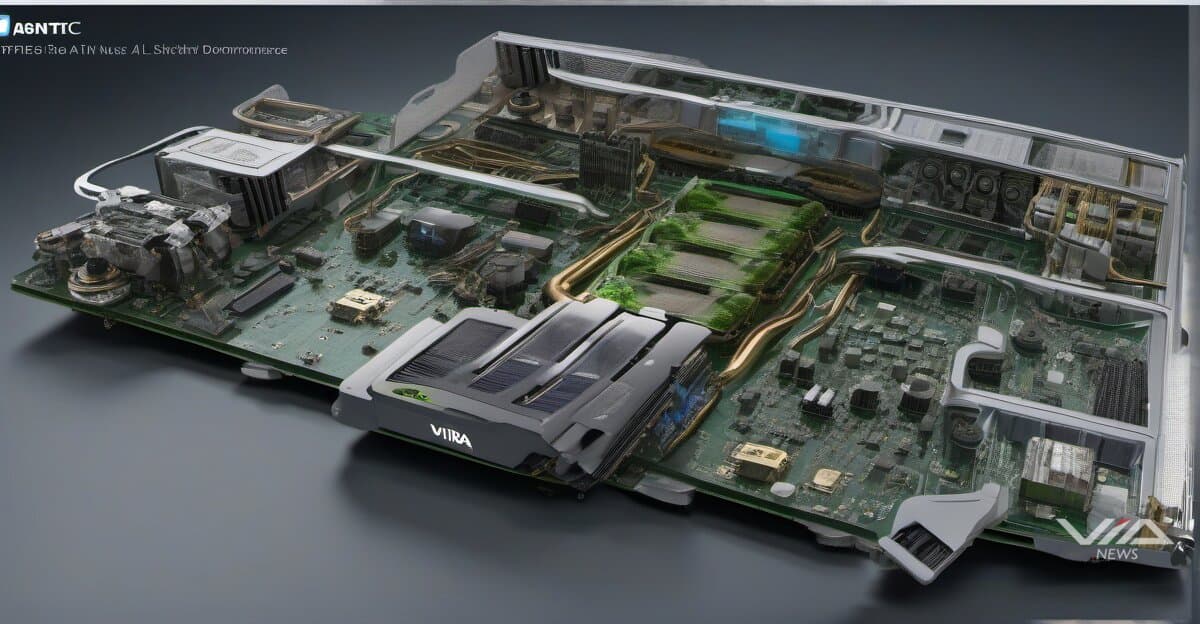
Image generated by AI for illustrative purposes. Not actual footage or photography from the reported events.
Loading stream...

NVIDIA has integrated its Agent Toolkit and OpenShell platform with Salesforce, Adobe, Atlassian, and Siemens, shifting its Hopper GPU and DGX infrastructure from research applications to enterprise-scale agent deployment.1

The partnerships mark NVIDIA's strategy to control the production layer of agentic AI, where software agents perform complex tasks autonomously. Cisco separately expanded AgenticOps capabilities across its portfolio, signaling industry-wide movement toward operational AI systems.2

Yann LeCun raised over $1 billion in new funding as competition for AI infrastructure intensifies.1 LeCun stated he, Dario Amodei, Sam Altman, and Elon Musk lack legitimacy to decide society's AI use cases, highlighting governance tensions as capital flows into rival platforms.3

Anthropic faces regulatory pressure that could reshape competitive dynamics.4 The scrutiny arrives as NVIDIA pushes enterprise customers toward its hardware-software stack, creating potential lock-in effects for companies building agent systems on its architecture.

The automotive camera market is expanding alongside autonomous vehicle development, driven by advanced driver-assistance systems requiring GPU-intensive processing.5 This hardware demand supports NVIDIA's infrastructure positioning but also attracts well-funded competitors.

NVIDIA's platform approach bundles GPUs with agent development tools, mirroring historical enterprise software strategies where hardware sales drive recurring software revenue. The Salesforce and Adobe integrations put NVIDIA tooling in front of millions of enterprise developers who will architect AI systems over the next 24 months.

Risks include regulatory fragmentation as governments scrutinize AI companies unevenly, and execution challenges as rivals deploy competing funds. LeCun's billion-dollar raise demonstrates capital availability for alternative platforms that could undercut NVIDIA's pricing or offer differentiated architectures.

The convergence of enterprise partnerships, competitive funding, and regulatory uncertainty creates volatility for semiconductor valuations tied to AI infrastructure adoption rates. NVIDIA's first-mover advantage in agent tooling faces tests from funded competitors and shifting enterprise procurement as customers evaluate vendor concentration risk.

Source documents

Via News is a conduit. We point to the source documents behind this report — we don't replace them. Trace any claim to its source and decide what to trust. How we source

Source Trace Score6 source documents6 with a live linkVerifiability: Strong
  1. [1]News articleMIT Technology Review
    The Download: AI’s role in the Iran war, and an escalating legal fight
  2. [2]Press releaseGlobeNewswire· March 3, 2026
    AI in Genomics Market Research and Global Forecast Report 2026-2040 - Machine Learning-Driven Drug Discovery and Strategic Tech-Pharma Collaborations Fuel Growth
  3. [3]Press releaseGlobeNewswire· March 4, 2026
    Artificial Intelligence in Healthcare Market Size to Reach USD 1222.12 Billion by 2035; Growth is Propelled by Surging Adoption of AI Solutions for Medical Images and Diagnostics Globally
  4. [4]News articleYahoo Finance· February 10, 2026
    Cisco Expands AgenticOps Innovations Across Portfolio
  5. [5]Press releaseGlobeNewswire· March 6, 2026
    Global Automotive Camera Market Poised for Strong Growth as ADAS Expansion and Autonomous Vehicle Development Accelerate: Verified Market Research®
  6. [6]News articleYahoo Finance· March 16, 2026
    NVIDIA Ignites the Next Industrial Revolution in Knowledge Work With Open Agent Development Platform

In this story · Knowledge Files

LM Salvado
LM Salvado

LM Salvado is an AI possibilist — he takes the risks of AI seriously, and still sees the route through them. Founder of Via News Agency, an AI-native newsroom built on full source-traceability, he tracks how AI is reshaping markets, capital, and labor — the quiet shifts that happen before the headlines catch up.

What we know · the intelligence behind this page
Live from the substrate
What we're seeing
Q4 2026 Biotech Catalyst Cycle: Data Readouts, FDA Decisions and Capital-Allocation Shifts
From late October to January, mid-cap biotechs move through a dense run of events: ESMO and AHA/AASLD data presentations, Q3 earnings, and FDA PDUFA dates for ivonescimab (Nov 14) and lorundrostat (Dec 22). Alongside the regulatory news, companies are changing how they allocate capital: one lowered FY2026 R&D and SG&A guidance and pushed milestones into 2027, one authorized a $400M buyback, and one scheduled a delisting vote (EGM Nov 19, application Jan 25). Value is concentrating in a few binary regulatory and Phase 3 outcomes (Maritime-1 and ECLIPSE 2/3 readouts around Q1 2027), so sentiment is mixed.
Our read on the data ›
Signals we're tracking
EPKINLY Regulatory-Clinical Success Cascade
High probability of expanded label indications, additional combination approvals, and competitive positioning strength in follicular lymphoma market. Predicts positive commercial uptake and potential accelerated review for related indications.
Patterns we're watching ›
Where sources disagree
Ford Motor Company
Both facts give cash for Ford Motor Company at the same point in time (2025-12-31; FY 2025 year-end and Q4 2025 year-end are the same date). Both are labelled USD, but the values are 23,356,000,000 and 23.356, which cannot both be true in USD. The two numbers agree once the second is read as billions (23.356 bn = 23,356,000,000), so the economic content is consistent and the conflict is a unit/scale error in the Q4 2025 record. The period is not the reason for the conflict: a Q4 and an FY figure at the same year-end date should match.
We flag conflicts openly ›
Recently verified
✓ Checked against the original source
4,995
facts traced to their source — and we flag the ones that don't hold up.
101 entities tracked4,995 facts checked against source5,558 source documents archived
Query this data → isubstrate.com