
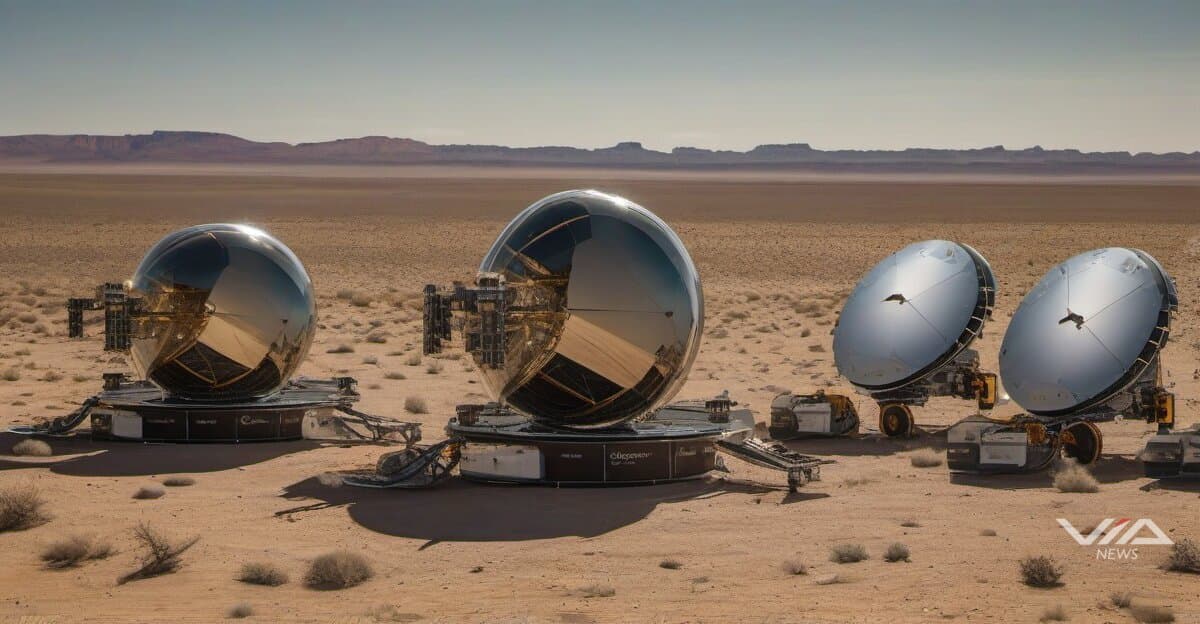
Planet Labs PBC (NYSE: PL) is preparing to take its most ambitious technological leap yet, with plans to deploy two SunCatcher prototype AI compute satellites — equipped with Google TPUs — in early 2027. The program, funded in part through a research-and-development partnership with Google (NASDAQ: GOOGL), positions Planet Labs not merely as an Earth observation company but as an emerging player in orbital AI infrastructure — a market that investors are beginning to price in seriously.
The SunCatcher announcement arrived alongside a Q3 FY2026 earnings report that gave the market concrete reasons for confidence. Revenue hit $81.3 million, up 33% year-over-year, while adjusted EBITDA came in at a $5.6 million profit — the company's fourth consecutive positive quarter on that metric. Free cash flow was positive for the third straight quarter, and the company's backlog surged 216% year-over-year to $734.5 million, with remaining performance obligations climbing 361% to $672 million. These are not speculative numbers; they reflect a business that is converting long-term contracts into durable, recurring revenue.
CEO Will Marshall and President and CFO Ashley Johnson have built a financial profile that increasingly resembles a platform business rather than a hardware play. Recurring annual contract value accounts for 97% of end-period ACV, with 83% structured as annual or multi-year agreements. Net dollar retention stands at 109%, indicating that existing customers are expanding their spend — a hallmark of software-like economics applied to satellite data.
The SunCatcher program sits at the intersection of two high-conviction investment themes: space commercialization and AI compute infrastructure. Rather than simply capturing imagery, the prototype satellites will carry onboard AI compute capacity powered by Google's Tensor Processing Units. This marks a shift from satellites as sensors to satellites as processing nodes — capable of running AI workloads in orbit, reducing latency and data transmission costs for time-sensitive applications.
Google's involvement is a meaningful signal. The partnership includes R&D funding, TPU hardware integration, and collaboration with Google's Gemini AI team. When a company of Google's scale co-develops a technology, it typically indicates both technical validation and a potential future commercial relationship. For Planet Labs, it also diversifies the revenue story beyond its core defense and civil government contracts.
Those core contracts remain the backbone of current growth. Defense and Intelligence revenue surged 70% year-over-year in Q3, driven by awards including a $12.8 million NGA LUNO b program contract, a $13.2 million NRO renewal, and a $7.5 million US Navy extension for Pacific vessel monitoring. NATO expanded a pilot program before completion — a rare vote of confidence. Meanwhile, a $13.5 million NASA task order anchors the civil government segment.
Planet Labs also closed the acquisition of Bedrock Research during the quarter, a Denver-based AI firm specializing in remote sensing and national security applications, further deepening its in-house defense intelligence capabilities.
The company raised $460 million in convertible notes at just 0.5% interest — cheap capital to fund capital-intensive satellite programs including the upcoming Owl constellation, which will feature NVIDIA GPU-powered onboard compute, and the SunCatcher prototypes. A capped call structure protects against dilution up to $18.04 per share.
Q4 guidance calls for revenue of $76–80 million and a temporary return to adjusted EBITDA losses of $5–7 million, reflecting elevated hardware prepayments and launch deposits. Full-year FY2026 guidance targets $297–301 million in revenue with $6–8 million in adjusted EBITDA profit — a company on a credible path to sustained profitability while simultaneously investing in the next generation of space-based AI infrastructure.
For investors tracking the convergence of AI and space technology, Planet Labs' SunCatcher deployment is a concrete milestone worth watching.