
Thursday, September 10, 2026

Nine NVIDIA GTC Taipei Partners in 48 Hours Signal Q3-Q4 Data Center Revenue Beat

Adobe, Microsoft, Canonical, Red Hat, Cadence, Siemens, Synopsys, NYSE, CrowdStrike, and Palantir all announced NVIDIA partnerships within a 48-hour window at GTC Taipei. Historically, multi-sector partnership clusters at GTC events precede NVIDIA quarterly revenue beats by 1-2 quarters as partners convert announcements to hardware orders. The pattern predicts NVDA data center revenue acceleration in Q3-Q4 2026.

LM Salvado
LM Salvado

June 8, 2026

Nine NVIDIA GTC Taipei Partners in 48 Hours Signal Q3-Q4 Data Center Revenue Beat
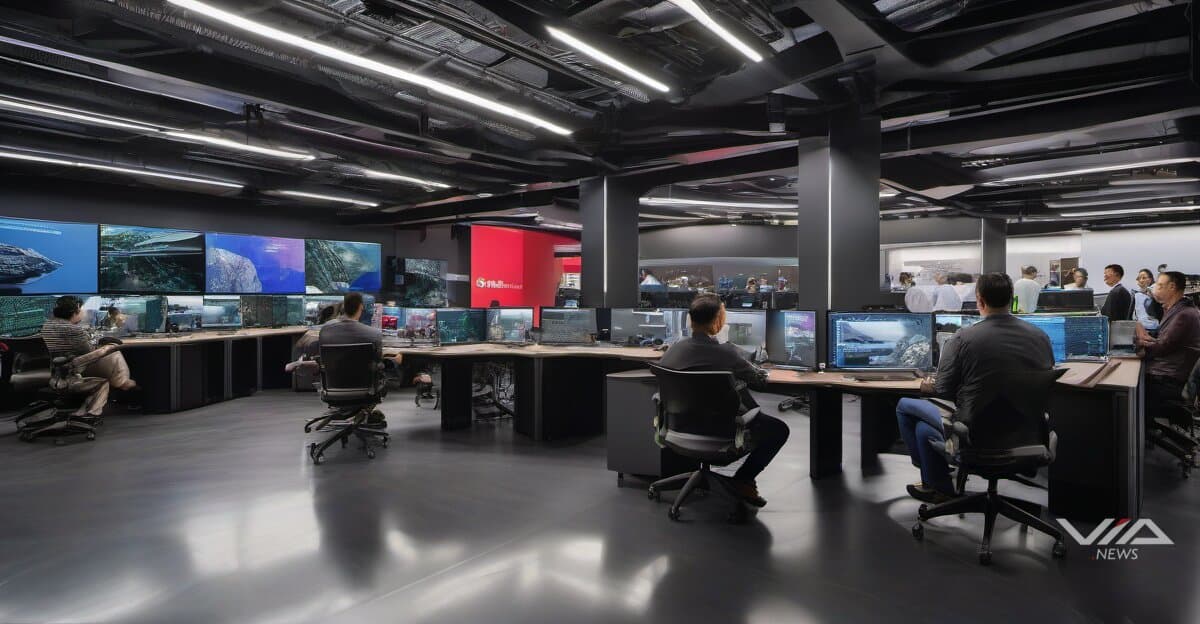
Image generated by AI for illustrative purposes. Not actual footage or photography from the reported events.
Loading stream...

Nine major companies announced NVIDIA partnerships within a 48-hour window at GTC Taipei: Adobe, Microsoft, Canonical, Red Hat, Cadence, Siemens, Synopsys, NYSE, CrowdStrike, and Palantir.1

When NVIDIA logs multi-sector partnership clusters at GTC events, quarterly revenue beats have followed within 1-2 quarters. Partners convert announcements to hardware procurement, and procurement becomes recognized revenue.1

The vertical spread is the signal's core value. These nine partners cover six distinct sectors: creative software (Adobe), enterprise OS (Canonical, Red Hat), electronic design automation (Cadence, Siemens, Synopsys), financial markets infrastructure (NYSE), cybersecurity (CrowdStrike), and defense and intelligence AI (Palantir).1

Single-sector clusters carry concentration risk. One vertical softening — say, EDA capex delays — can push revenue out a quarter. A six-vertical cluster distributes that risk across independent budget cycles and buying timelines.1

NYSE's inclusion stands out. Financial exchanges adopting NVIDIA infrastructure signal latency-sensitive, institutional-grade deployments. These differ from hyperscaler bulk orders: they tend to be smaller in volume but stickier, with multi-year replacement cycles.

CrowdStrike and Palantir add non-cyclical demand. Security and government AI budgets track threat environments and policy cycles, not consumer or enterprise tech spending. Their presence reduces correlation to broader market softness.

The signal points to NVDA data center revenue acceleration in Q3-Q4 2026.1 The 1-2 quarter lag reflects typical hardware procurement timelines: agreement, purchase order, delivery, deployment, and billing.

Risks remain. Partnership announcements can stall at procurement approval. Macroeconomic headwinds can delay capex decisions. Individual partner budget freezes can push orders out. The pattern is a leading indicator, not a guarantee.

For traders tracking NVDA into its next earnings cycle, the GTC Taipei cluster is a breadth signal worth weighting against incoming partner capex disclosures and data center order flow over the next two quarters.

In this story · Knowledge Files

About this analysis

This is a Via News analysis. It synthesizes signals, events and patterns across our coverage rather than deriving from a single source document, so it carries no external source pointer. Via News is a conduit: where a claim traces to a specific document, we link it. How we source

LM Salvado
LM Salvado

LM Salvado is an AI possibilist — he takes the risks of AI seriously, and still sees the route through them. Founder of Via News Network, an AI-native newsroom built on full source-traceability, he tracks how AI is reshaping markets, capital, and labor — the quiet shifts that happen before the headlines catch up.

What we know · the intelligence behind this page
Live from the substrate
What we're seeing
AI Capital Boom Meets Valuation Jitters: Funding Surges While Bellwether Stocks Wobble
A dense wave of AI-sector funding (Socure, Stability AI, Emerald AI, Generalist AI, Gatik, Regent Craft and others closing rounds on the same day) and strong enterprise-automation earnings (UiPath raising full-year guidance) point to continued heavy capital deployment into AI infrastructure, fintech-adjacent AI, and agentic automation. Yet Palantir's stock fell even after winning the Army's high-profile TITAN contract, and commentary (e.g., the Alphabet bull case citing AI capex and regulatory risk) signals growing investor unease about whether current AI valuations and spending levels are sustainable.
Our read on the data ›
Signals we're tracking
Satellite-Terrestrial Network Integration Acceleration
Increased investment and launches in hybrid satellite-cellular networks across telecom industry; competitive responses from other carriers; regulatory activity around satellite spectrum; expansion of emergency/rural connectivity use cases
Patterns we're watching ›
Where sources disagree
JPMorgan Chase & Co.
Both facts represent the same entity (JPMorgan Chase & Co.), same attribute (EPS), and same observation date (2025-12-31), which aligns with FY 2025 year-end reporting. Fact A explicitly states FY 2025 with EPS of 20.02 USD/share. Fact B has an unspecified fiscal period (N/A) but reports 4.63 USD, a significantly different value (4.3x lower). Given identical observation dates and the same metric, both facts appear intended to represent FY 2025 annual EPS. The conflicting values (20.02 vs 4.63) constitute a direct contradiction. The N/A period in Fact B suggests incomplete or corrupted metadata rather than legitimate time-period variation.
We flag conflicts openly ›
Recently verified
Checked against the original source
4,981
facts traced to their source — and we flag the ones that don't hold up.
101 entities tracked4,981 facts checked against source5,278 source documents archived
Query this data → isubstrate.com