
Saturday, August 22, 2026
What we know · the intelligence behind this page
Live from the substrate
What we're seeing
AI Platforms Rush to Establish Content-Authenticity Standards Amid Leadership Shakeups and Sustained Capex
Within days of each other in mid-August 2026, Google, Anthropic, and Spotify moved to formalize AI content watermarking and labeling policies, signaling an industry-wide push toward self-governed provenance standards as generative AI output floods consumer platforms. The shift coincides with executive turnover at OpenAI (Brad Lightcap's departure) and Meta's public AI manifesto, all set against continued heavy AI infrastructure capital expenditure and finance-sector moves (e.g., Wall Street paying for algorithmic edges on social signals) that underscore AI's deepening entanglement with capital markets.
Our read on the data ›
Signals we're tracking
Satellite-Terrestrial Network Integration Acceleration
Increased investment and launches in hybrid satellite-cellular networks across telecom industry; competitive responses from other carriers; regulatory activity around satellite spectrum; expansion of emergency/rural connectivity use cases
Patterns we're watching ›
Where sources disagree
JPMorgan Chase & Co.
Both facts report JPMorgan Chase & Co.'s revenue for the same fiscal period (FY 2025) with the same observation date (2025-12-31), but with different values: $182.447 billion vs. $185 billion. The ~1.4% difference ($2.553 billion) is too large to be explained by rounding alone and represents conflicting data for the identical time period.
We flag conflicts openly ›
Recently verified
Checked against the original source
4,977
facts traced to their source — and we flag the ones that don't hold up.
101 entities tracked4,977 facts checked against source5,242 source documents archived
Work with this data → vianewsagency.com

US-China Chip Export Controls Split AI Semiconductor Market Into Competing Ecosystems

New US restrictions on Nvidia chip exports to China, paired with Beijing's approval of select H200 processors and accelerated Huawei development timelines, are creating permanently divergent AI hardware markets. The bifurcation forces semiconductor investors to evaluate dual supply chains built around incompatible CUDA and CANN software frameworks.

L.M. Salvado
L.M. Salvado

March 30, 2026

US-China Chip Export Controls Split AI Semiconductor Market Into Competing Ecosystems
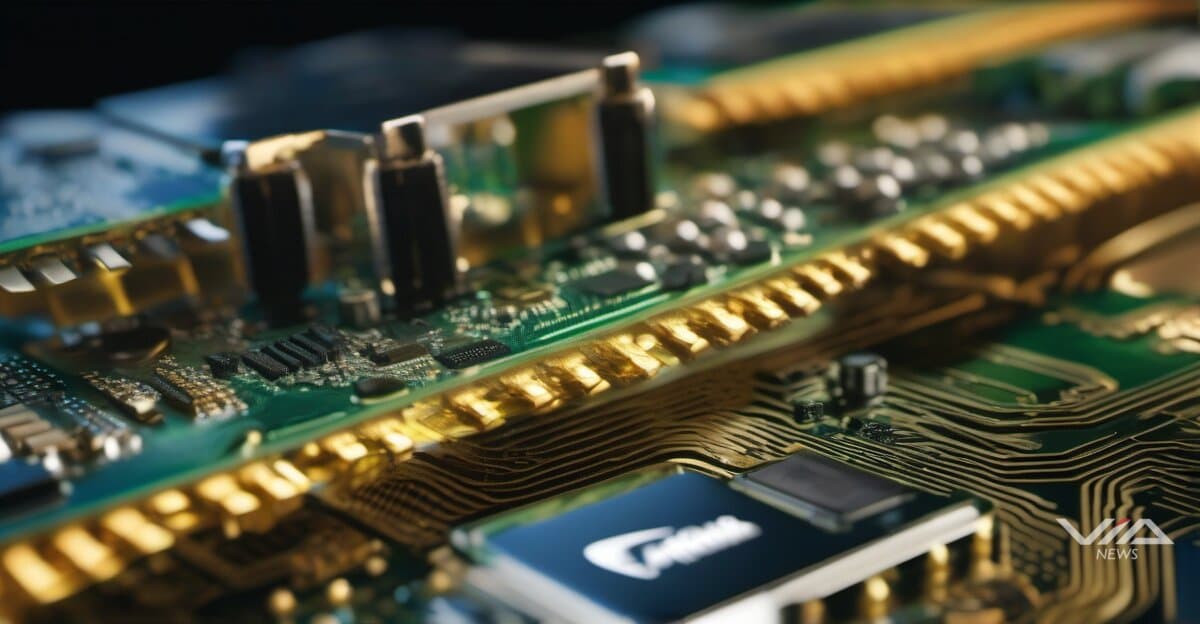
Image generated by AI for illustrative purposes. Not actual footage or photography from the reported events.
Loading stream...

US export bans on Nvidia AI chips to China and China's simultaneous domestic approval of specific Nvidia H200 models are fragmenting the global semiconductor market into separate ecosystems.1 The coordinated regulatory moves signal structural decoupling rather than temporary trade friction.

Huawei has accelerated its 950PR chip development timeline in response to the restrictions, creating a parallel AI infrastructure built on its CANN software framework rather than Nvidia's dominant CUDA standard.1 This technical divergence extends beyond hardware specifications to encompass incompatible development tools and trained AI models.

The split creates distinct investment landscapes. China-focused AI infrastructure companies now operate in a protected domestic market insulated from direct Nvidia competition. Multinational firms face duplication costs maintaining separate product lines for each regulatory zone.

Semiconductor supply chain valuations reflect the bifurcation. Companies serving exclusively Chinese customers avoid export compliance costs but lose access to global scale economies. Manufacturers with dual-market capabilities carry complexity premiums in their cost structures.

Alternative chip manufacturers gain positioning advantages. AMD and Intel can potentially serve markets where Nvidia faces restrictions, though replicating CUDA's software ecosystem remains technically challenging. Chinese domestic producers like SMIC benefit from guaranteed local demand regardless of performance gaps with western equivalents.

The diverging standards create switching costs that entrench the bifurcation. AI models trained on CUDA infrastructure cannot easily migrate to CANN-based systems. Developers specializing in one framework lack immediate portability to the other, fragmenting technical talent pools.

Long-term implications favor scale players with resources to maintain parallel operations. Smaller semiconductor firms must choose between market access and regulatory complexity. The chip industry's previous assumption of unified global standards no longer holds for AI-specific processors.

Investors evaluating semiconductor positions now require geopolitical hedging strategies alongside traditional technology assessments. Pure-play exposure to either market carries regulatory risk, while diversified approaches face margin compression from duplicated infrastructure.

In this story · Knowledge Files

About this analysis

This is a Via News analysis. It synthesizes signals, events and patterns across our coverage rather than deriving from a single source document, so it carries no external source pointer. Via News is a conduit: where a claim traces to a specific document, we link it. How we source

L.M. Salvado
L.M. Salvado

L.M. Salvado is an AI possibilist — he takes the risks of AI seriously, and still sees the route through them. Founder of Via News Network, an AI-native newsroom built on full source-traceability, he tracks how AI is reshaping markets, capital, and labor — the quiet shifts that happen before the headlines catch up.