Micron, SanDisk Among 2026's Top Chip Gainers as AI Memory Demand Tightens Supply
Micron and SanDisk are among 2026's top-performing chip stocks on AI memory demand, but both have fallen sharply from June record highs. Figures dated and sourced.
32 articles
Micron and SanDisk are among 2026's top-performing chip stocks on AI memory demand, but both have fallen sharply from June record highs. Figures dated and sourced.
TSMC CEO C.C. Wei raised 2026 capital expenditure guidance to $52-56 billion after diligence with customers, while SK Hynix listed on the Nasdaq this week. Analysts expect AI data center capex to grow 40-50% next year, with memory chips taking a larger share of equipment sales.

Geely Auto sold 3,024,567 vehicles in 2025 — 39% year-on-year growth — as its AI-integrated safety platform drove demand above target. JVP recorded four exits in Q1 2026, recycling VC capital from enterprise data vintages into regulated-industry AI deployments. A bifurcated timeline is forming: commodity AI ships in H2 2026, frontier autonomous and robotics silicon arrives 12–30 months later.

Cloud computing ETF WCLD has fallen 22% year-to-date as futures markets assign just a one-in-three chance of any Federal Reserve rate cut in 2026. Higher-for-longer rates are compressing growth equity valuations across AI and cloud stocks. Jerome Powell's term ends May 15 with hawkish nominee Kevin Warsh advancing through Senate confirmation.

New U.S. regulations will prohibit Chinese rare earth materials in defense systems starting 2027, forcing semiconductor supply chain diversification. The move coincides with major industry shifts including Tim Cook's departure from Apple, Panasonic Automotive's rebrand to Mobitera, and Nvidia's Vera Rubin architecture launch, signaling a strategic pivot toward supply chain independence and AI-focused applications.

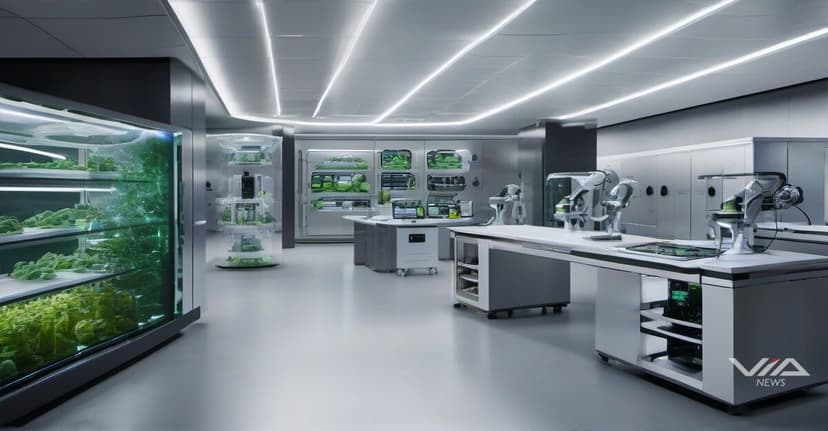
NVIDIA is pivoting from traditional GPU sales to integrated AI-biotech solutions through its BioNeMo platform, securing partnerships with pharmaceutical giants Eli Lilly and Thermo Fisher.<sup>1</sup> The platform enables autonomous lab workflows for computational drug discovery, positioning NVIDIA as infrastructure provider for the biotech AI sector. This diversification strategy opens new revenue streams beyond the company's core semiconductor business.
ARM will sell its own chips for the first time, targeting $15 billion in annual revenue within five years as AI demand reshapes semiconductor manufacturing. Camtek secured $31 million in AI packaging orders while Wolfspeed cut $97 million in debt to fund domestic capacity expansion amid supply chain realignment.

The AI robotics sector is transitioning from research to commercial deployment, with Tesla targeting 2027-2028 for Optimus humanoid robots and Cybercab autonomous vehicles. VERSES AI closed private placement funding to advance intelligent agentic systems, while Boulder Imaging's IdentiFlight AI vision technology achieved 95% bird mortality reduction with under 1% energy loss in wind farm applications.

Boulder Imaging's IdentiFlight AI system achieves 95% bird mortality reduction at wind farms while limiting energy losses to under 1%, attracting growth investment from Lime Rock New Energy. VERSES AI closes second tranche of private placement to fund development of nature-inspired intelligent agentic systems. The deployments signal expanding commercial applications for specialized AI vision platforms.

NVIDIA's BioNeMo platform is gaining traction among pharmaceutical and life sciences companies, with Eli Lilly and Thermo Fisher implementing AI-driven drug discovery tools. Multiple biotech firms including Natera, Basecamp Research, and Owkin are building foundation model platforms on NVIDIA's infrastructure, signaling a shift toward autonomous biological research systems.

Samsung is positioning for expanded AI chip production through strategic partnerships and capital investment. The moves indicate a broader semiconductor sector shift toward advanced memory and foundry capacity to meet AI infrastructure requirements. Industry watchers expect additional capacity announcements within 90 days as the capital expenditure cycle enters expansion phase.
Huawei launched its 950PR AI chip to challenge Nvidia in inference workloads, with Alibaba and ByteDance planning orders. Chip equipment makers like Lam Research report strong growth while AI startups secured double the funding in Q1 2026 versus all of 2025. Memory sector shows mixed signals with equipment strength but commodity weakness.
US export restrictions on Nvidia AI chips to China are forcing multinational tech companies to build parallel computing infrastructures across geopolitical boundaries. Huawei plans to ship 750,000 Ascend 950PR processors this year as Chinese firms like ByteDance and Alibaba shift to domestic alternatives. The bifurcation creates duplicate capital expenditures for any company operating in both markets.

Huawei plans to ship 750,000 units of its 950PR AI chip this year as ByteDance and Alibaba prepare orders following successful testing. The chip's CUDA compatibility addresses a key migration barrier for Chinese developers previously locked into Nvidia's ecosystem.

Three major banks raised Cisco price targets by approximately $5 per share following the company's expanded NVIDIA partnership for AI infrastructure. The Secure AI Factory collaboration supports NVIDIA Spectrum-X networking and includes participation in a new 400G optical consortium.

OpenAI's chief scientist Jakub Pachocki says AI models are approaching the capability to work indefinitely without human intervention, positioning the industry toward fully automated research facilities. The shift drives demand for specialized infrastructure, benefiting NVIDIA's RTX PRO 6000 Blackwell workstations for data science applications and AI-focused companies like Palantir, which gained 6% as automation infrastructure spending accelerates.

NVIDIA's Cosmos 3 world foundation model, Isaac GR00T robotics platform, and Metropolis VSS Blueprint v3 are catalyzing enterprise deployment of computer vision AI across infrastructure monitoring, autonomous vehicles, and industrial inspection. Physical AI developers including Levatas, Waabi, Milestone Systems, Inchor, and Voxelmaps are building specialized vision agents on NVIDIA's platforms. Semiconductor earnings from Micron, XPeng, and Alibaba signal accelerating hardware demand supporting

NVIDIA locked enterprise integrations with Salesforce, Adobe, Atlassian, and Siemens for its Agent Toolkit and OpenShell platform, positioning Hopper GPUs and DGX systems for production agentic AI deployment. The moves come as Yann LeCun secured over $1 billion in funding while regulatory pressure hits Anthropic, intensifying competition for AI infrastructure market share.

NVIDIA's GTC 2026 conference catalyzed immediate enterprise adoption of its OpenShell and Agent Toolkit platforms, with Adobe, Salesforce, HPE, Siemens, and Atlassian announcing integrations.<sup>1</sup> The move signals a strategic shift from standalone AI models to standardized agentic frameworks for autonomous enterprise workflows. Parallel quantum computing advances show 25x performance gains in hybrid classical-quantum integration.

NVIDIA unveiled three industry-specific AI platforms on March 16, 2026: Space Computing Platform with the Space-1 Vera Rubin Module, warehouse automation through partnerships with KION and Siemens, and EDA tool integrations with Cadence, Siemens, and Synopsys. The move signals a strategic pivot from general-purpose GPU sales toward domain-optimized solutions that could reshape the company's revenue mix through 2027.